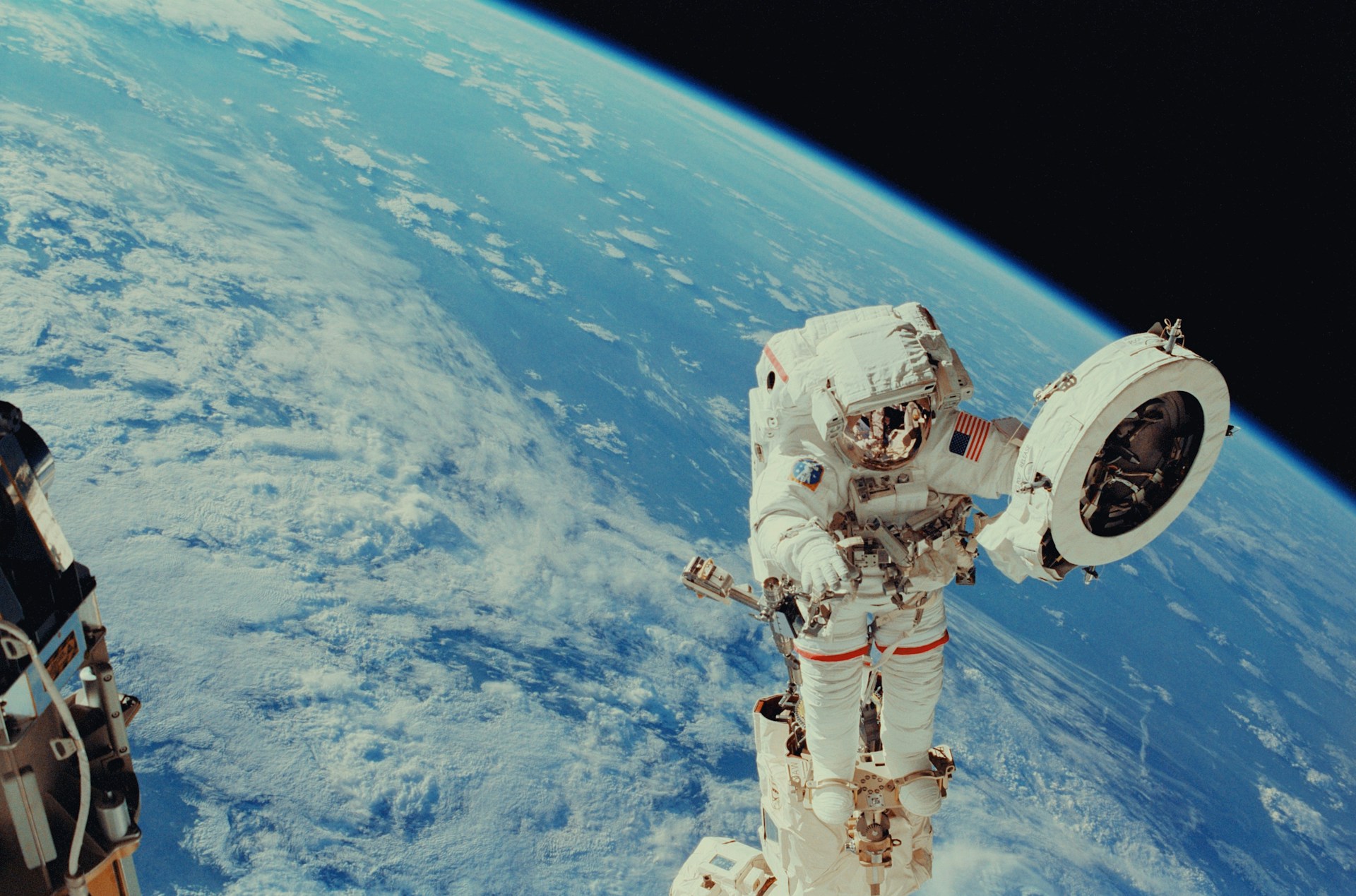
Although space exploration can answer questions about the origins of life and drive scientific advancements, can the benefits of space exploration outweigh the disadvantages? Photo credit: NASA via Unsplash
Humans have been intrigued by space and what lies beyond our planet since as early as the Neolithic period, with the construction of Stonehenge. It was purported to have been built in accordance with the lunar and solar alignments that happen at midsummer and midwinter, perhaps marking holidays. Stonehenge might also have been used as a cemetery, so it may have been used to mark days of remembrance long before the existence of the Gregorian (365 days a year) calendar. Therefore, space and the advancement of mankind have walked hand-in-hand as we use space as a tool, in culture, and as a source of general and scientific curiosity, driving major technological innovations. Despite this, as space becomes increasingly commercialised, with profit prioritised over advancement, we perhaps lose this human perspective. Space exploration could improve global quality of life, but going to space isn’t exactly a global endeavour.
…space and the advancement of mankind have walked hand-in-hand as we use space as a tool, in culture, and as a source of general and scientific curiosity, driving major technological innovations.
The first object sent to space was an artificial satellite, which was successfully launched into the Earth’s orbit in 1957. This satellite was the Soviet Sputnik 1, invented amidst the Cold War, marking a pivotal advancement in the “Space Race” between Russia and the USA. Sputnik 1 could be monitored visually from Earth and by radio transmission, which was significant because this allowed for a greater understanding of the properties of the atmosphere. The theory discovered behind satellite pressurisation, which refers to the maintenance of atmospheric pressure in a spacecraft, would eventually be adapted to allow for the control of the cabin pressure of spacecraft. These spacecrafts, among many other innovations, were able to mimic the vital conditions of Earth in the microcosm, allowing humans to leave the planet for the first time. This presented, in Neil Armstrong’s words, a ‘giant leap for mankind’, despite all the tensions and ideological differences that pervaded this milestone.
Now, satellites are used in everyday life. One example is in navigation, as the Global Positioning System (GPS) relies on a network of satellites to identify users’ near exact location by using the time differences from satellites’ radio wave signals to determine the distance to a desired location. Satellites are also used in global communications as a medium for the transport of radio waves, allowing phone calls, emails, etc., to take place anywhere worldwide. They are also used in weather forecasting by meteorologists, providing real time data on slight changes in the atmosphere. Building on weather forecasting, satellites can be used in farming to anticipate extreme weather conditions so farmers can act accordingly (for example, switching to drought-resistant crop plants or conserving water) and can continue producing food and other natural resources to not lose their livelihoods.
Back down to Earth, space exploration has informed us of the conditions of our planet and improved understanding of what makes it hospitable to life. Missions to space, as a space crew or with rovers, allow us to investigate the possibility of extraterrestrial life. This brings us to question whether life only emerges within narrow chemical constraints. If life were to be discovered on another planet, this could cause a paradigm shift in our understanding of biology if these extraterrestrial life forms use an alternate set of biomolecules or arrange their stores of genetic information in different structures. If the basis of their chemistry was not organic (carbon-based), defining life would become even harder as we begin to consider a universal perspective, still with little representation of what alternate extraterrestrial life forms could exist.
If life were to be discovered on another planet, this could cause a paradigm shift in our understanding of biology.
If we instead discovered alien civilisations, perhaps we could make contact and establish trade routes, technology exchange, and become part of some universal network. We might find civilisations more socially and technologically advanced than our own, but this does not mean they would not be hostile towards us—despite the development we have made on our planet, we continue to be hostile among ourselves within or across borders. This would introduce difficulties if an alien civilisation waged war against our largely ununified planet, because it would be challenging to come to a global consensus, especially when certain countries are more influential than others. Certain countries may believe their word is stronger than others, or they may act in their own interests. Conversely, the threat of our species’ extinction would perhaps cause the opposite effect. I W Howerth said ‘a nation is a herd’ when corralled against a common enemy, so an extraterrestrial planetary threat could create a sense of internationalism.
We need not to look beyond the sky for hostility, as war and violence are rampant and at eye level for many. Space could be used as a tool for violence. The US has, for the first time, confirmed to have deployed a space weapon into the Earth’s orbit, igniting fears of a neo-Cold War with weapons developed ‘for offensive and defensive purposes’. This violates the 1967 Outer Space Treaty, which put a ban on launching weapons of mass destruction from space. Other global superpowers such as China and Russia are also accused of such violations, developing satellites that intercept the communication of others, and allegedly might even be able to destroy them. Therefore, there is no actual restriction as to how space exploration can be used to harm others. With major space research being largely concentrated in a small number of countries and funded by their governments, it is impossible to remove the geopolitical aspect of going to space, which itself might be a source of armed conflict in the future.
Even if we go to space with the positive intent of conducting research and pushing the limits of technology, the funding for it must come from somewhere, and it is not a light expense. For example, the International Space Station (ISS) has, over the past 10 years, cost approximately €100 billion to run. Running purely for the benefit of science, the ISS doesn’t generate any income. Some argue that expenditure on outer space research should be used to improve the lives of people here on Earth, but given space exploration and research only makes up less than 0.05% of the British government’s spending, this is a short-sighted argument. While cutting all funding would immediately create more money to allocate to welfare, it would likely not be enough to support the thousands of people who have lost their jobs not only in the space industry but in academia, journalism, and finance, and farmers for reasons previously mentioned.
Not all space research is government-funded; there are private space companies such as SpaceX and Boeing with their own intentions for space exploration, which consider a much smaller audience of people. These are companies that cannot survive without profit, so they prioritise it above all, disregarding other factors. As private companies launch more satellites into orbit, there is a greater chance of collisions between them, which could affect global communications and weather forecasting. Furthermore, space tourism could have tremendous negative effects on the environment as the fuels used release vast volumes of greenhouse gases such as carbon dioxide. A single rocket launch may release 200-300 tonnes — up to 100 times more than single commercial flight—so if space flight became commercialised and more frequent, global warming could be seriously exacerbated.
The expansion of space exploration does not exist in a vacuum, therefore the weight of the trade-offs of each possible benefit should be considered. While not always immediate, these benefits may have a huge impact. Ultimately, the quality of life for those on Earth should not be compromised due to pursuits outside of it, but it is the governance on our planet’s responsibility to maintain a balance. Mankind should continue to go to space in pursuit of knowledge, as an international effort not motivated by economic gain, but this doesn’t mean space travel should be made accessible to the everyday earthly person.
Ultimately, the quality of life for those on Earth should not be compromised due to pursuits outside of it.
Some ideas expressed in this article are opinion, and may not represent the opinion of The Oxford Scientist as a whole.
Edited by Isha Yadav, Mia Clark-Webb, and Sophie Lyne.