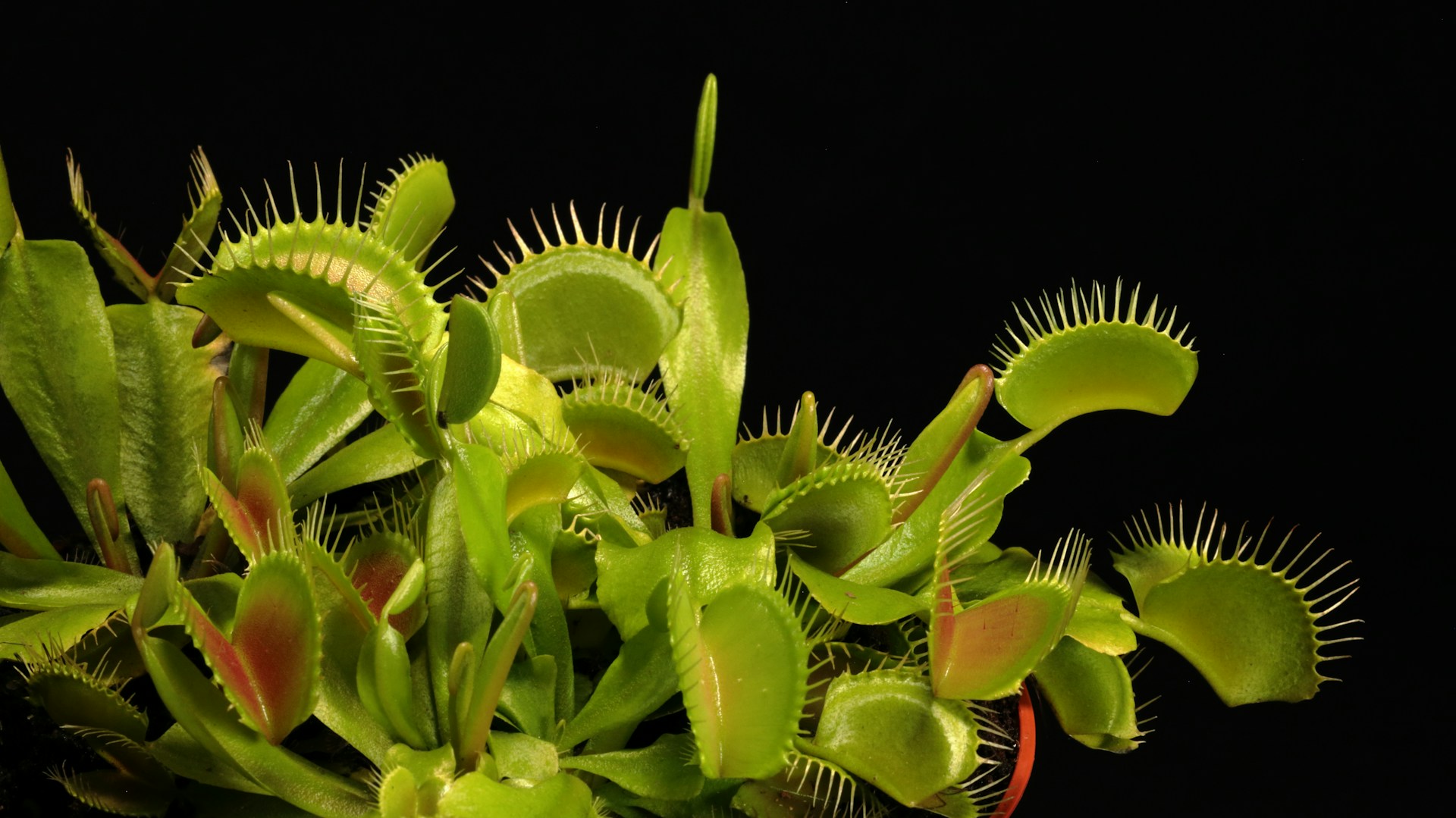
Carnivorous plants have adapted rheir immune system, allowing them to consume animals. Photo credit: Andi Superkern via Unsplash
For much of evolutionary history, the distinction between plants and animals has been clear: plants are the producers, animals are the consumers. This distinction has driven an arms race for plants to defend themselves against their environment, and for animals to circumvent said defences. What happens when this distinction is broken, and how could such behaviour evolve?
Breaking down barriers to survive:
The term carnivorous comes from the Latin for “flesh consuming”. In order for a plant to be described as such, it must capture, kill, and digest prey, absorb their metabolites (nutrients), and use them for growth and development—this is the “carnivorous syndrome”. Five major methods of prey capture have been described in these plants: adhesive traps (Drosera spp.), pitcher traps (Nepenthes spp.), snap traps (Dionaea muscipula), lobster-pot traps (Genlisea spp.), and suction traps (Utricularia spp.). Such traps exploit the malleability of plant physiology and leaf morphology to redirect metabolism away from nutrient production via photosynthesis, and toward nutrient consumption through predation. These oddities in nature have inspired some of the most memorable pop culture figures such as the monstrous Audrey II from The Little Shop of Horrors and Detective Comics’ antiheroine Poison Ivy. The evolution of their unique behaviour was first hypothesised by Charles Darwin in Insectivorous Plants.
…it must capture, kill, and digest prey, absorb their metabolites (nutrients), and use them for growth and development—this is the “carnivorous syndrome”.
There are 19 genera of these plant carnivores, representing 10 lineages and roughly 800 species which arise in environments with high rainfall, and nutrient-poor soil. These conditions allow denitrifying species of bacteria to metabolise nitrate, the only soluble source of nitrogen for non-carnivorous plants, from the soil. The pitcher trap leaves of Nepenthes spp., Sarracenia spp., and Heliamphora spp. form large basins holding digestive fluid, into which ants, termites, and even animal faeces fall into. The adhesive traps of Drosera spp. secrete glistening drops of digestive sap on their surface, forming a biological glue-trap for prey. Such species rely on chemical stimulation of their traps from metabolites such as chitin, a major component of insect exoskeletons, to stimulate enzyme release from specialised glands. This behaviour allows for the generation and absorption of soluble nitrogen-containing compounds for sustenance.
D. muscipula, the Venus Flytrap, is likely the most well-known plant carnivore, being sold in garden centres across the world and admired for their fascinating snap traps that entomb struggling prey before digesting them. Biochemically, these traps have a unique method of detecting prey, as electrical stimulation of trigger hairs contributes to trap function alongside chemical stimulation. Most other species, however, rely solely on chemical stimulation.
In all plant carnivores, digestive fluid that forms in this trap is dynamic, and undergoes a series of changes during its lifetime—the composition varies by species, but that is beyond the scope of this article. The fluid is low in nutrient composition, but sugars that are present help thicken the juice to help retain prey. The capture of prey stimulates the release of hydrochloric acid, helping digestive enzymes, like proteases and chitinases, to degrade the insect carcass.
How do plants normally defend themselves?
The strange behaviour of carnivorous plants holds many secrets, and the answers can be found in the immunological behaviour of these organisms. In the plant kingdom, immunity is organised in a similar way to humans, but the plant adaptive immune system, termed systemic acquired immunity (SAR), plays a very minor part in how they defend against pathogens; the majority of plant immunity is innate and genetically encoded. This region of plant immunity can also be organised into groups of receptor proteins based on the signal they respond to; Pattern Triggered Immunity (PTI) receptors detect microbial and damage signals extracellularly, while Effector Triggered Immunity (ETI) receptors are located inside cells, and are stimulated by effector molecules that originate from pathogen action.
PTI is the first line of defence for plants and relies on the formation of signalling complexes in the membrane from pattern recognition receptors (PRRs), co-receptors, and other proteinaceous components. In these complexes, the intracellular domains of the PRR serve as platforms for other signalling components. ETI is the more robust system of plant defence and is governed by a gene-for-gene model proposed by Flor in 1971—receptors are coded by resistance (R) genes that directly counteract the harmful action of proteins encoded by pathogenic avirulence (Avr) genes. Most R genes encode proteins that assemble into membrane channels called that allow for calcium ion transport into the cell.
Cells are sacrificed in order to limit the spread of infection.
Both systems converge on similar downstream responses mediated by calcium ion influx into the cells causing the release of plant hormones (phytohormones) such as jasmonic acid (JA). This initiates organism-wide defence mechanisms, which manifest as the release of protective enzymes, other signalling molecules, and antimicrobials. The hypersensitive response (HR) is essential for containing infections in plants and involves the production of toxins, condensation of genetic material, disruption of organelle structure, and loss of cell membrane integrity. Cells are sacrificed in order to limit the spread of infection.
How defence responses turned predatory.
The extreme habitats of plant carnivores are the major driving factor for the development of their unique behaviour: a lack of nutrients in the soil, high rainfall, and a low frequency of encounters with pathogens has created a clear evolutionary message—these organisms must claim as many resources from their environment as possible. It is not surprising that the repertoire of immune receptors in carnivorous plant species is declining, relative to those of their sister, non-carnivorous species. The non-carnivorous primary model organism Arabidopsis thaliana has roughly 200 R genes, whilst the carnivorous Nepenthes mirabilis has only 62. This reduction of the ETI demonstrates the need to conserve metabolic resources in such tough environments. When immunity is not a priority for these organisms, the underlying biochemical machinery undergoes different selective pressures and can be repurposed for the acquisition of nutrients.
The extreme habitats of plant carnivores are the major driving factor for the development of their unique behaviour.
It was initially thought that the enzymes involved in prey digestion were only of microbial origin. This is the case for some species including Sarracenia spp. and Heliamphora spp., but studies involving sterilised plant traps showed that enzymes were present in the prey-free traps of Nepenthes spp. and Ultricularia spp. and were secreted upon stimulation in D. muscipula. Such enzymes are secreted in non-carnivorous plants during immune responses, producing toxic antibiotics and antimicrobials to stop an infection. Similar enzymes that are involved in digestion also produce toxic substances that must have their effects regulated with inhibitors of cell death to prevent autodigestion of the plant’s own tissues. Recent advancements in molecular tools have allowed for the analysis of less abundant digestive fluid components, but the roles of many are still unknown.
The molecular link between prey capture and enzyme secretion is the JA pathway, the phytohormone referenced before as a key downstream component of immune signalling. Studies in A. thaliana reveal that both electrical and calcium signals stimulate JA release, and that JA signalling alters the gene expression of chitinases and many pathogenesis-related genes. The supplementation of prey capture by administering JA triggers the release of pathogenesis-related enzymes, and the discovery of this link is what developed the hypothesis that plant carnivory is immunologically derived. The reconfiguration of the JA pathway has also been documented across multiple orders including Ericales and Caryophyllales, displaying convergent evolution, where the same trait evolves independently more than once.
Where do we go from here?
As the biochemistry behind plant carnivory is investigated, the hypothesis that it is rooted in immunology is only strengthened. While other phytohormones have not been implicated in carnivory, there is growing evidence supporting the idea that these chemical compounds are mediators of the carnivorous response. Current research in this area has highlighted that the main roadblock in studying these fascinating organisms is the lack of sequencing data of genomes and transcriptomes. The advent of massive parallel sequencing technologies such as Oxford Nanopore can greatly advance the amount of data available to interrogate these hypotheses and answer questions about how carnivorous plants evolve and what lessons they can teach us about their non-carnivorous relatives.
Edited by Elliot Middleton, Anikah Lau and Mathilda Lang.