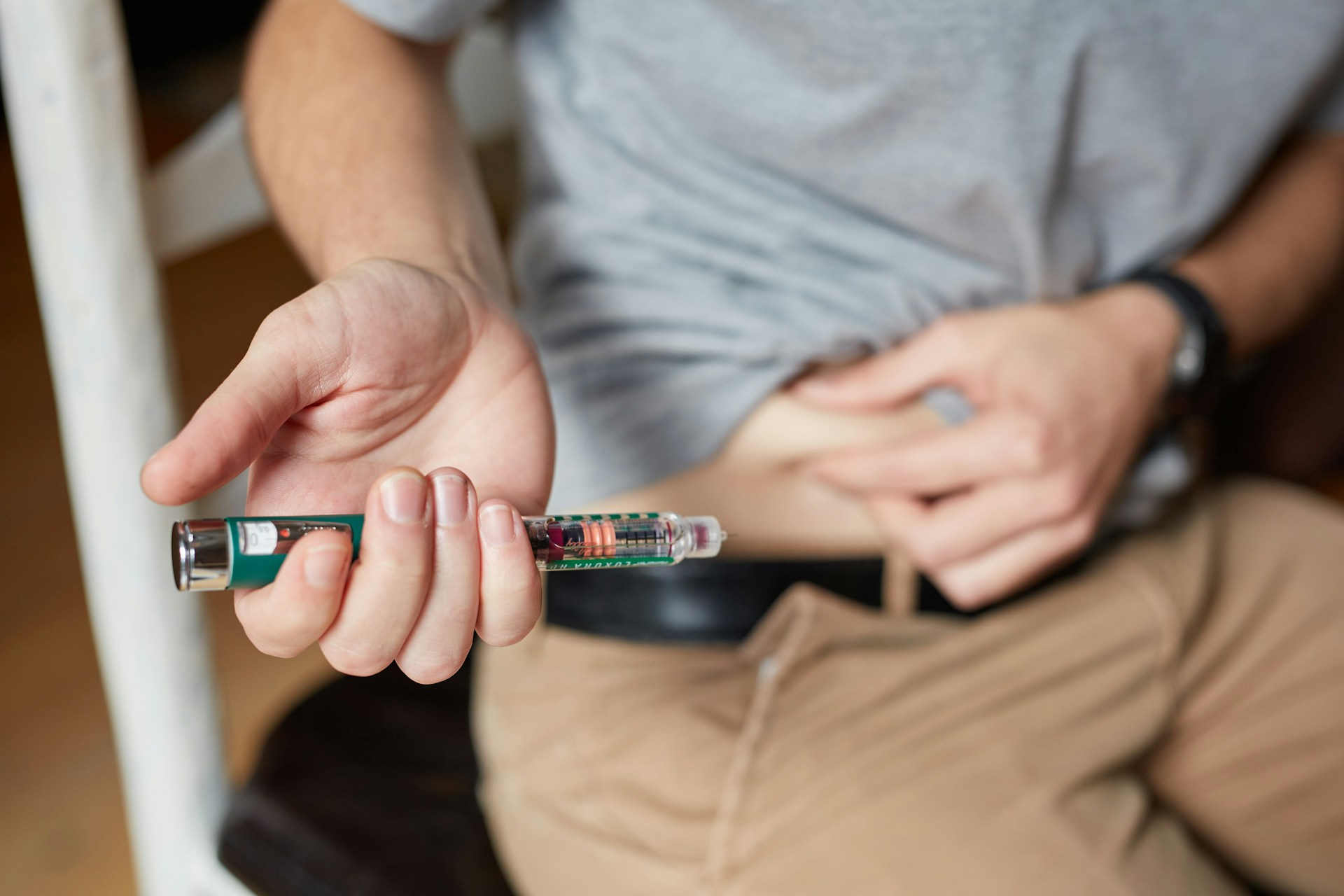
AI can be used in various aspects of drug discovery, but patenting AI-designed drugs is difficult due to questions regarding human contribution and our current definition of ‘invention’. Photo credit: Towfiqu barbhuiya via Unsplash
Traditionally, drug development has been highly inefficient, taking an average of 10–15 years and costing $0.8–1.9 billion when unsuccessful molecules are taken into account. AI is reducing this burden, but also reducing the need for human inventorship.
Computational methods have supported drug discovery for decades. These include ligand docking (predicting how a drug binds to its target molecule), pharmacokinetic prediction (estimating how the drug’s concentration will change once inside the body), and virtual screening (identifying drugs most likely to bind to a desired target from a large library of candidates). Unlike classical methods, which simulate established chemical and physical rules, artificial intelligence (AI) uses pattern recognition and data-driven prediction to accelerate analysis.
AI can be integrated into every stage of the drug discovery pipeline, helping to relieve known bottlenecks. For example, it can rapidly analyse clinical, genomic, and protein databases to identify novel drug targets, which are often enzymes or receptors involved in a particular disease. Once a target is identified, compound screening is used to find a molecule that interacts with it in the desired way. This is a painstakingly long process in which a large library of known compounds is tested against this target in the hope of finding a molecule that not only binds to it but also produces the intended effect, such as inhibition.
AI can use historical data to predict the likelihood of drug failure before costly and time-consuming trials are undertaken in animals and humans.
Instead of simply searching existing molecular libraries, AI can create new molecules according to predefined properties specified by the researcher. Of the candidates identified through traditional screening, 90% of them fail during the early stages of clinical evaluation because they are ineffective or toxic. AI can use historical data to predict the likelihood of drug failure before costly and time-consuming trials are undertaken in animals and humans. There are also uses for AI in drug repurposing, where an existing drug is used to treat a condition beyond its original application, and in clinical trial design, where it can help select appropriate candidates and streamline data management.
The introduction of AI into the pharmaceutical industry is expected to increase the speed and reduce the cost of drug development: it is forecast to increase the value of the pharmaceutical sector by $60–110 billion per year, and to double overall pharmaceutical output by reducing the time taken to generate drug candidates from years to months.
The introduction of AI into the pharmaceutical industry is expected to increase the speed and reduce the cost of drug development.
Although no AI-designed drug has yet been approved for clinical use, multiple patents have been filed for compounds in early-stage development. A patent is an exclusive legal right granted in respect of an invention. This means that the relevant government recognises the patent holder (a pharmaceutical company) as having exclusive rights over the invention (a new drug) and can prevent competitors from making, using, or selling it without permission. Patents are therefore important for protecting the potential financial return on the substantial costs of drug development.
To obtain a patent, an invention must meet several criteria, including the identification of a human inventor. In 2022, Dr Stephen Thaler challenged this requirement by naming his AI system, DABUS, as the sole inventor of a patent application. US courts held that an inventor must be a ‘natural person’, therefore excluding AI systems from inventorship. The European Patent Office (EPO) and UK Intellectual Property Office (UKIPO) adopted similar positions. This creates a dilemma for pharmaceutical companies, which rely on patents to protect drug discoveries but increasingly use AI in drug design to remain competitive.
In 2024, guidance clarified that AI-assisted inventions could be patented where a ‘natural person’ instead made a ‘significant contribution’. This assessment initially relied on the Pannu factors, which were originally developed for joint human inventorship. However, these guidelines still anthropomorphise AI, creating legal confusion and contradiction. In 2026, revised global guidance was introduced for examining patent applications involving AI inventions. Although these changes improved clarity, obtaining patent protection for AI-assisted inventions remains complex and continues to challenge traditional ideas of human inventorship.
Imagine you are a chemist seeking to target a known protein associated with a disease, and you instruct an AI model to generate a compound that meets a set of criteria, such as size, toxicity, and stability. You hit “go”, and the model produces this novel compound. The question is, are you the inventor?
Current US law dictated that an invention is ’formed in the mind of the inventor of a definite and permanent idea of complete and operative intention’, meaning the answer to the above question is no. Current international guidance indicates that merely identifying a research problem or recognising and validating an AI-generated solution does not, by itself, establish inventorship.
AI is enabling and fast-tracking the development of new drugs for diseases previously thought to be incurable...
The fundamental principle guiding patents is to provide financial incentives to individuals by offering them recognition for their creativity. This in turn encourages innovation, which assures that the quality of human life is continuously enhanced. Some argue that the mainstream use of AI is dulling human creativity and lowering the threshold for inventorship. On the other hand, AI companies such as OpenAI and Anthropic insist that machine learning is not replacing human artistic creativity, but have not commented on its impact on inventorship. Some people point out that, as with other technological innovations, AI is enabling and fast-tracking the development of new drugs for diseases previously thought to be incurable (e.g. Parkinson’s disease), or/and replacing less effective drugs (potentially overcoming issues such as antibiotic resistance). In this way, it may improve the quality of human life. For example, Insilico Medicine’s INS018_055 a treatment for idiopathic pulmonary fibrosis, developed using generative AI, is now in phase III clinical trials, in which the new treatment is compared against current standard care to confirm efficacy. This important development marks a global shift in the standard drug design pipeline and the scope of AI application.
Another example is Exscientia’s DSP-1181, an AI-designed drug for obsessive-compulsive disorder. Unfortunately, despite the use of machine learning assistance, the drug failed in Phase I clinical trials, highlighting that AI-assisted drug design does not guarantee success and that human insight remains valuable. For example, human expertise can help identify unusual results, interpret smaller or inconsistent datasets, and provide the contextual judgement needed to move research from computational work to wet lab testing and, eventually, clinical application.
…highlighting AI-assisted drug design does not guarantee success and that human insight remains valuable.
Another patent requirement is that an invention must be non-obvious, meaning it must involve an inventive step that would not be readily apparent to an average professional in the field. For example, improving a car’s speed simply by reducing its weight would generally be considered an obvious development. In AI-assisted drug design, if a colleague could use the same prompt and arrive at the same compound, the invention may be considered obvious and therefore not patentable. As AI tools become a standard part of work and research, the threshold for what counts as non-obvious may need to be reassessed to reflect the capabilities of someone with access to AI.
Without significant human contribution and a strong case for non-obviousness, an AI-derived drug may be unpatentable. Current guidance advises pharmaceutical companies to carefully document the innovation process, particularly including human actions such as designing the AI model, curating a novel dataset, and constructing a highly specific, detailed prompt.
Although AI may lower the cost of drug design across many stages, pharmaceutical companies will still depend on patent protection to recover development costs. Patent guidance will therefore need to keep evolving to support AI-driven innovation.
Edited by Phoebe Bedford, Eva Knightley and Mathilda Lang.