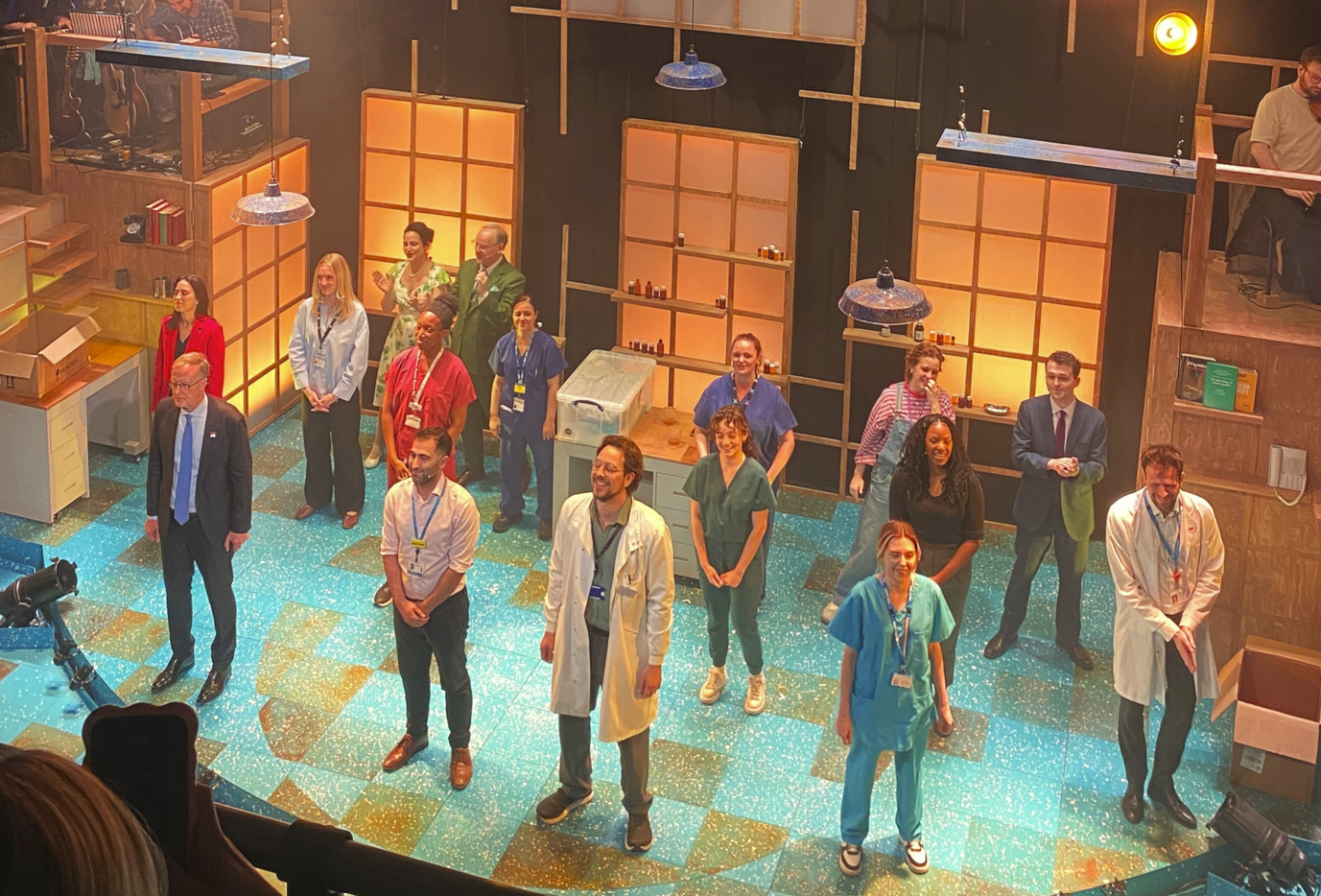
A new musical shines a spotlight on antimicrobial resistance and the frontline heroes fighting it. Photo credit: Julia Talarek via the Oxford Scientist.
A quietly growing threat is killing millions each year—more than AIDS, malaria and lung cancer combined. It is known as antimicrobial resistance (AMR) and Lifeline is launching it into the spotlight.
Lifeline…puts the fight against AMR centre-stage while celebrating those confronting it daily: healthcare workers, scientists, and patients.
Lifeline is a musical breaking new ground by using the emotive power of theatre to communicate this vast global issue to the public. After successful runs at the Edinburgh Fringe, off-Broadway, and a first-of-its-kind performance at the United Nations, Lifeline now arrives at Southwark Playhouse on the West End. Described as ‘a heartfelt love letter to the medical community’, this musical puts the fight against AMR centre-stage while celebrating those confronting it daily: healthcare workers, scientists, and patients.
Lifeline is shaped by two mirroring storylines: the historic discovery of penicillin by Sir Alexander Fleming and the lived experience of a modern-day junior doctor navigating today’s medical challenges. These storylines are not only joined together by the imminent threat of AMR but are intertwined by themes of love.

Fleming serves as a warning from the past. The experiences in the army that first shaped his commitment to antimicrobial research are spotlighted and his Scottish heritage is reflected in the folk musical score. Known as ‘the man behind the mould’, Fleming is at the height of his fame when penicillin is being acclaimed as a miracle cure. This acclaim is bitterly contrasted by his haunting foreshadowing of the AMR crisis. As early as 70 years ago, he warned that the misuse of antibiotics would allow bacteria to adapt and develop resistance. Lifeline presents this as the double-edged nature of medical progress: even a promising breakthrough can carry unintended consequences.
Amalia’s character further broadens the historical storyline. A Greek resistance fighter and scientist working alongside Fleming, she represents the importance of international collaboration in scientific progress. Rather than existing solely as a romantic counterpart, Amalia gestures towards the overlooked contributions of women and immigrants within scientific history — a problem many continue to face today.
Fast forward to the present, we see Fleming’s prediction become reality. Antimicrobial resistance is now a global emergency, and Jess, a modern-day junior doctor, is grappling with this issue, as many doctors currently are. Alongside the daily pressures of hospital life, the story intensifies as Jess’ childhood sweetheart is rushed into hospital with a critical infection, one which mirrors the countless cases she faces every day.
Each week, the musical features a rotating chorus of healthcare professionals, scientists and policymakers who confront the challenges of AMR in their everyday work.
Jess’ character emphasises the dedication of healthcare workers who spend their lives saving others, often with remarkable resilience and courage. Ordinary people doing extraordinary work — this lies at the heart of the production. Laced with diversity, humour, inclusivity, and profound humanity, Lifeline shines a light on those working on the frontlines. Each week, the musical features a rotating chorus of healthcare professionals, scientists and policymakers who confront the challenges of AMR in their everyday work. Their presence reinforces the scale of this healthcare challenge and invites the audience to consider their own role in addressing it.
What makes this show stand out is its effective blend of real-life science and storytelling. The medium of theatre is incredibly effective at bringing the urgency of this issue into focus, particularly through the integration of real patient experiences into Jess’ daily life. These moments serve as a reminder that this is not just a narrative but an ongoing global crisis that is already shaping everyday medical care. In this way, Lifeline provides an emotional grounding to this crisis and encourages public engagement.

The musical further confronts the extensive scale of the problem when Jess fails to spark policy change to combat AMR. Antibiotics are everywhere: fed to livestock, infused into fish farms, in our rivers, and in the ground. This vast and constant selective pressure enables bacteria to adapt and outsmart these lifesaving drugs. Without the development of new treatments and reductions in antibiotics misuse, resistance will only grow.
Lifeline seeks to change this trope through real-life stories, the vibrancy of theatre, and with the help of those fighting AMR every day.
AMR is not a distant problem. Currently, one in six laboratory-confirmed bacterial infections is resistant to all antibiotic treatments. Routine surgeries are becoming riskier, and once-treatable infections are no longer guaranteed a cure. Despite this, this global emergency remains largely undiscussed. Lifeline seeks to change this trope through real-life stories, the vibrancy of theatre, and with the help of those fighting AMR every day. By giving a voice to healthcare workers, scientists, and patients at the centre of the narrative, this musical ensures that the AMR crisis is not only understood, but felt.
Edited by Emmi Lamont, Lisa Tsoi and Sebastian Evans.