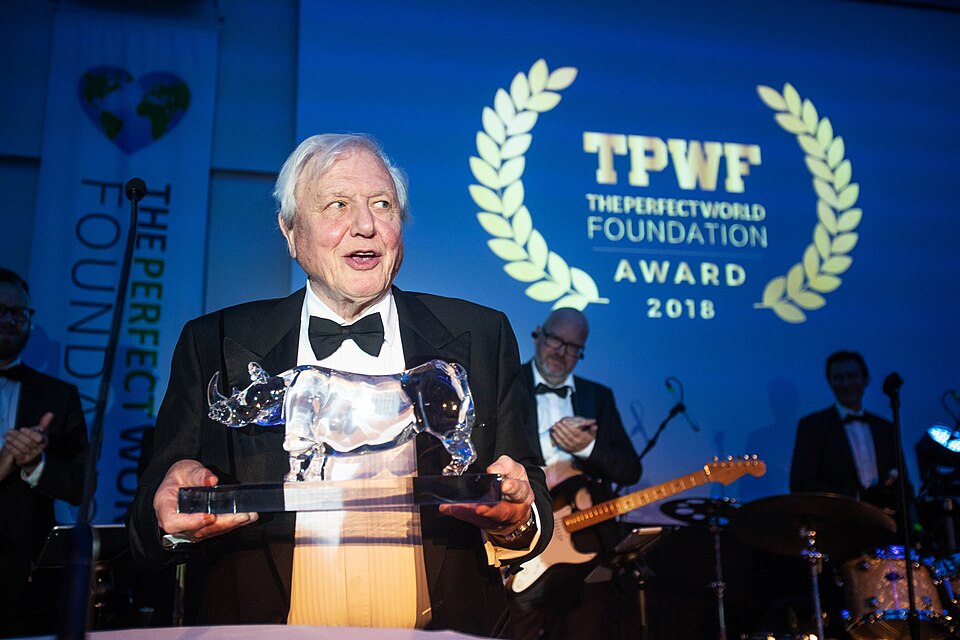
David Attenborough’s centenary marks not only a remarkable life, but a legacy that transformed nature into a shared cultural experience. Photo credit: Danielwilke1 via Wikimedia Commons, CC BY-SA 4.0
It is a real honour that my first Culture by the editor piece can be dedicated, on behalf of everyone here at The Oxford Scientist, to wishing Sir David Attenborough many happy returns for his 100th birthday.
Attenborough has shaped how we imagine the natural world: how it looks, how it sounds, how it moves, and why it matters.
As you may have seen across news outlets and celebratory posts last week, the much loved and widely considered “national hero” David Attenborough was born a century ago, on 8 May 1926. Reaching such a milestone in his life has led me to reminisce about what he stands for as an undeniable cultural icon. To mark his 100th birthday is not simply to celebrate a long and extraordinary life: it is to recognise a figure who has changed the cultural place of nature itself. For decades, Attenborough has shaped how we imagine the natural world: how it looks, how it sounds, how it moves, and why it matters. In many ways his work has been central in bringing nature into the public cultural sphere, bringing hope back into the spotlight of nature conservation, an attribute often lacking in our modern world.
The facts of Attenborough’s life have been widely covered, but they are valuable for the role they play in shaping his cultural influence. He was born in London and educated in Leicester before moving to study Natural Sciences “over the pond” at Clare College Cambridge in 1945. Here, his studies in zoology and geology gave him the scientific grounding that shaped his future work. In a move to change the cultural landscape for generations to come, Attenborough later joined the BBC, with his first major documentary series Zoo Quest airing from 1954. Since then, audiences around the world have watched his stories and activism unfold in real time. The success of his documentaries in British households has made them a regular staple and has propelled his career globally, cementing nature as a shared domestic and cultural experience.
His work reached a new level of influence with the 1979 series Life on Earth, watched by up to 500 million people worldwide. The programme was an enormous undertaking, involving travel to 49 countries in three years, aiming to tell what Attenborough described as ‘the greatest story in all the world’—that of the history of life on our planet. This was not just a successful programme, but a moment that helped define wildlife documentary as a major television form. The reframing of wild nature as a story to be told to the public provided the basis for further global work, including The Living Planet and Planet Earth (scoring 100% on rotten tomatoes) followed by Planet Earth II and III. The mark they left on the industry of nature documentaries is undeniable, employing state-of-the-art high-definition imagery to reframe what audiences expected nature to look like on screen. Attenborough’s work has taken an increasingly urgent tone throughout the 2010s as climate change and biodiversity loss became more apparent, aiming to incentivise social and political action.
Many of Attenborough’s documentaries inspire passion through showcasing the wonders of the natural world in faraway places…But this year, the release of Wild London has shifted his focus, celebrating the diversity of urban wildlife at our doorsteps.
It is easy to underestimate the true power that a household name can have in transforming a generation’s outlook, but as a Biology student I know this all too well. Often the first name friends and new acquaintances will bring up (with joy) is Attenborough’s, simply demonstrating his astounding cultural impact. Wildlife documentaries play an incredibly important role in bridging the gap between everyday modern life and the direct experience of nature. Children often now first encounter nature through images, voices, stories and repeated viewing, essential for fostering interest. Many of Attenborough’s documentaries inspire passion through showcasing the wonders of the natural world in faraway places, ranging from the Serengeti to the Bornean rainforests to the Mariana Trench. But this year, the release of Wild London has shifted his focus, celebrating the diversity of urban wildlife at our doorsteps. This has important cultural significance, bringing the UK to the forefront of nature documentaries that have often taken on a mystical and distant tone in the past. Attenborough highlights the successful recolonisation of London by peregrine falcons, nesting in civic and cultural locations from the Houses of Parliament to the Tate Modern, the skilful navigation of urban foxes, and most importantly garden initiatives by residents looking to help wildlife themselves.
Perhaps this reflects a wider societal need to bring nature home. This is nowhere better explained than by the man himself, who said ‘If children grow up not knowing about nature and appreciating it, they will not understand it, and if they don’t understand it, they won’t protect it, and if they don’t protect it, who will’?. Growing interest in nature schools, initiatives such as meat free Mondays, and World Earth Day show the dissemination of pro-wildlife ideas into society, and crucially into the early years of education. It might also reflect a craving to reconnect with nature that is growing as access to it gradually disappears. The recent work of Attenborough tightly links to a broader cultural shift, where the influence of wildlife documentaries is feeding positive change, which in turn supports bringing natural activism to the forefront of media.
Uniting often impenetrable scientific research and light-hearted entertainment is difficult, but Attenborough has demonstrated it is essential…
Storytelling creates familiarity, and familiarity can become affection and curiosity towards the natural world. Through generations of documentaries, Attenborough has shown that hope can be more powerful than fear in motivating conservation. We can only wish in turn that this forms the groundwork to inspire and change the message of action in this generation and those to come. On the centenary of David Attenborough’s birth, we must look to learn from him and his dedicated career. At The Oxford Scientist, we aim to make our reporting of science accessible and engaging, but with high scientific integrity. Uniting often impenetrable scientific research and light-hearted entertainment is difficult, but Attenborough has demonstrated it is essential, and the public have unbounded interest in the world around them. Through welcoming communication in student science journalism, we can look to persist in advocating for the natural world and those incapable of speaking for themselves; to confront environmental threats without surrendering to despair; and above all to nurture the wonder and the care provided by Attenborough’s cultural legacy.
Edited by Joshua Sains and Sophie Lyne.