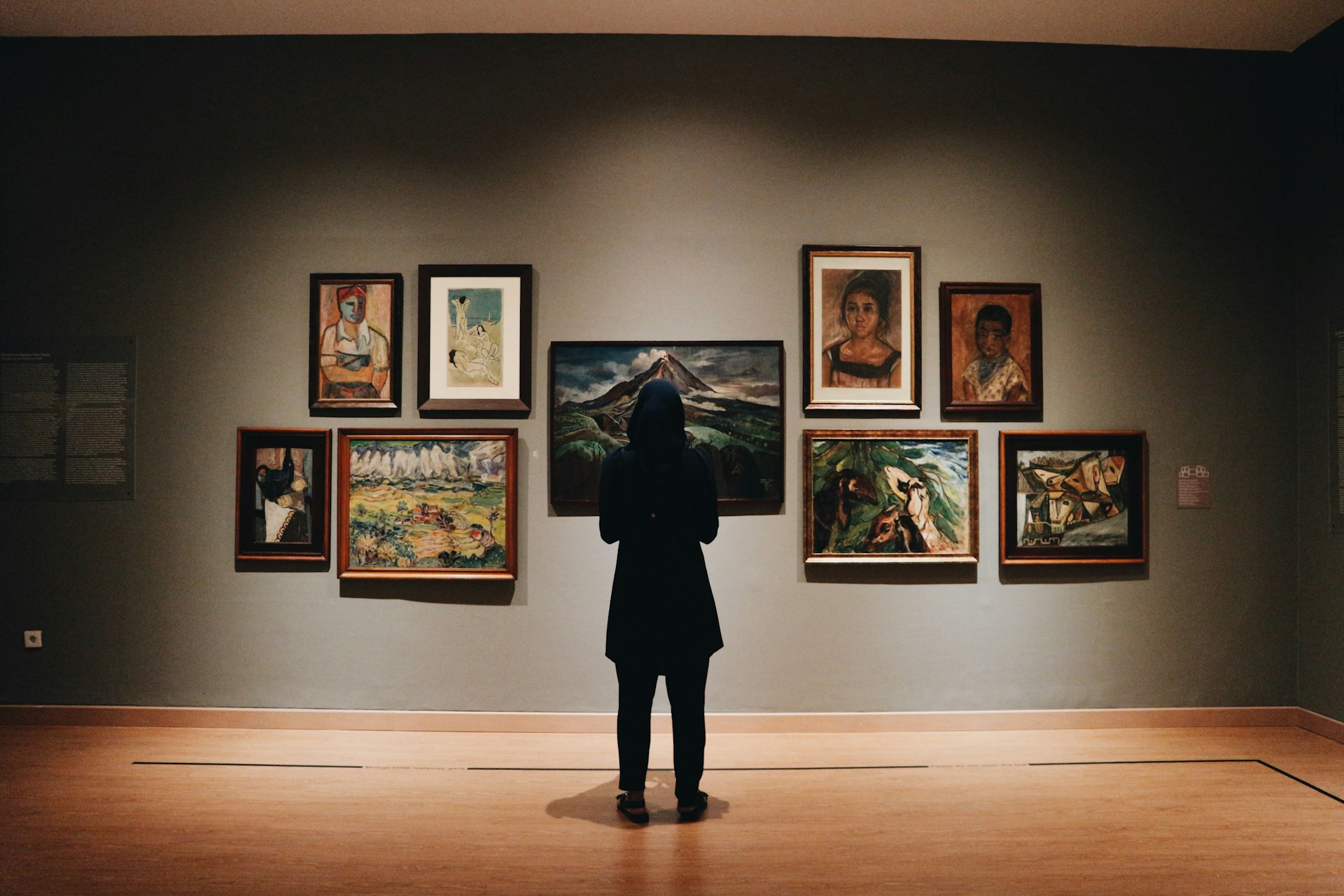
Thinking about climate change can often make people feel powerless and afraid, but artwork can give us a new perspective. Photo credit: Zalfa Imani via Unsplash
Climate change dominated headlines throughout the summer of 2026. It was Western Europe’s hottest summer on record, bringing relentless heatwaves, droughts, and wildfires. The United Nations warned that exceeding the 1.5°C global warming target is now largely unavoidable, a worrying milestone in international efforts to curb the effects of climate change.
The science has been clear for decades, but the constant stream of alarming climate news can leave us feeling powerless. This fear and distress about the future of our planet is often described as climate anxiety. While these feelings can motivate action, they can also give way to a more fatalistic outlook, sometimes called climate doomerism. When environmental destruction begins to seem inevitable, it’s difficult to imagine what meaningful action could achieve. If we believe the future is already decided, why bother trying to change it?
Over the past few months, two art exhibitions have made me think about climate change differently. By engaging our emotions and imagination, art could offer something that scientific communication alone cannot: a way to confront the seriousness of the crisis without losing sight of the future we still have the power to shape.
Art could offer something that scientific communication alone cannot: a way to confront the seriousness of the crisis without losing sight of the future we still have the power to shape.
In Other Worlds
This summer, I visited In Other Worlds, an immersive exhibition by artist and filmmaker Liam Young at the Barbican Centre in London. Through various art forms, the exhibition took me through a series of imagined futures, exploring humanity’s changing relationship with the environment. Some of these worlds seem impossible, but they aren’t presented as mere science fiction—they’re possibilities shaped by decisions still in our hands.
Building a better future isn’t just about developing new technologies. It also means confronting the damage caused by colonial exploitation and rethinking our relationship with the land.
One of the works that stayed with me most was After the End, co-written by Aboriginal actor and activist Natasha Wanganeen. The film follows the lives of Australia’s First Nations peoples (Aboriginal and Torres Strait Islander peoples), through colonisation and resource extraction, to an imagined future where fossil fuels have been abandoned and stolen lands returned to Indigenous communities. Oil rigs become the foundations of new island cities, while abandoned gas plants are reclaimed and repurposed as artificial reefs. There’s something strange about seeing the remnants of an industry that has shaped so much of our modern world become the starting point for something entirely different. Building a better future isn’t just about developing new technologies. It also means confronting the damage caused by colonial exploitation and rethinking our relationship with the land.

Another imagined future, Planet City, takes a more radical approach. Here, the entire human population lives in a single, densely populated city, leaving the rest of the planet to regenerate. An architectural model reminded me of photographs I’d seen of Hong Kong’s Kowloon Walled City, where thousands of people once lived in a tightly packed maze of interconnected buildings. At first, the prospect seemed dystopian. Yet through film, elaborate costumes, and storytelling, Young imagines a city alive with culture, including a year-long festival celebrating traditions from around the world. Rather than proposing a realistic blueprint for the future, Planet City challenges our assumptions about how we could live. It seems we have become more accustomed to imagining the end of the world than radically different ways of living.

I couldn’t stop thinking about the exhibition for weeks afterwards. To me, climate change had always felt like an inevitable future we were heading towards, regardless of what we did. Young’s work challenged that assumption, making me consider how much of the future remains undecided.
There’s a difference between acknowledging the seriousness of climate change and accepting its worst outcomes as inevitable. Optimism doesn’t necessarily mean ignoring the science or pretending that the challenges ahead will be easy. If anything, imagining a future worth working towards gives us more reason to act. I left In Other Worlds thinking less about what the future might hold for me, and more about what role I might have in shaping it.
Climate Culture Care
At the Ashmolean Museum, Bangladeshi artist Soma Surovi Jannat takes a more intimate approach to the climate crisis. Her exhibition, Climate Culture Care, explores environmental destruction through the lives of those already experiencing its consequences.
Much of her work draws inspiration from the Sundarbans, the world’s largest mangrove forest, spanning approximately 10,000 square kilometres across Bangladesh and India. The region is home to endangered wildlife and communities whose livelihoods depend on the surrounding ecosystem. It is increasingly threatened by rising sea levels, cyclones, and environmental degradation.
One of the exhibition’s most striking pieces is ‘Between the Sea and the Sky, Who Holds the Ground?’, a nearly ten-metre-long scroll filled with intricate depictions of humans, animals, and the natural world. Elephants wander among treetops, displaced from their habitats, while a procession of climate refugees gradually transforms into insects, reflecting how migrants are treated as unwelcome outsiders. The imagery is almost overwhelming in its detail, with human and animal experiences overlapping across the scroll.
From a distance, the work appears as one enormous, interconnected landscape. Moving closer, however, reveals individual stories of displacement and loss that might otherwise go unnoticed. It made me think of how we tend to encounter climate through a broad lens: global temperature increases, rising sea levels, and millions displaced by climate disasters. These figures are important, but their sheer scale can make it difficult to understand what they mean for individual lives.
…their sheer scale can make it difficult to understand what they mean for individual lives.
This becomes even clearer in ‘She Carries the River in Her Skin’, a large drawing spanning two gallery walls. Five boats represent the struggles faced by women in the Sundarbans. These include the effects of saltwater contamination on reproductive health and the social isolation experienced by women who have lost their husbands to tiger attacks. The work draws attention to how environmental crises deepen existing inequalities, with women and children facing consequences that extend far beyond the immediate effects of natural disasters.
The drawing encourages visitors to step closer to examine its details before stepping back to take in the whole scene. I moved between the two, noticing something new each time. There’s a contrast here with the way we often consume climate news, scrolling past headline after headline before we’ve really had time to process it. In a museum, we’re encouraged to slow down and pay attention.

Surovi doesn’t make the climate crisis seem any less daunting, but she makes it harder to reduce to an abstract problem. Her work draws attention to the people and places behind the statistics, raising questions about our responsibility towards communities already living with the consequences of climate change.
Final thoughts
Can the emotional impact of climate art translate into meaningful action? For me, art has encouraged me to think more carefully about my own choices, from changing my dietary habits to reconsidering how sustainability might shape my career. I also find myself talking more openly about climate change with friends and feeling more optimistic about what we can achieve together. My actions alone cannot address a crisis of this scale, but adopting a new perspective has made me feel less powerless in the face of it.
These exhibitions follow a wider tradition of environmental art, which has sought to challenge our relationship with the natural world for decades. Art cannot replace science, which helps us understand the scale of the crisis and gives us measurable goals to work towards. That said, knowing what needs to change isn’t always enough to motivate us to act. When the constant stream of climate news begins to lose its urgency, art can remind us why we should care, and what might still be possible.
‘After the end, new worlds take shape from what remains’
One line from In Other Worlds stayed with me: ‘After the end, new worlds take shape from what remains’. Imagination and optimism can seem naive in the face of such a crisis, but perhaps we’ve underestimated how much we need them. We cannot undo every consequence of climate change, nor can we guarantee a better future. What we can do is refuse to treat the worst possible outcome as the only one.
After all, we cannot build a future that we’ve already given up imagining.
Edited by Pimrapat Srihawan, Mariam Elantably and Emily Lamont