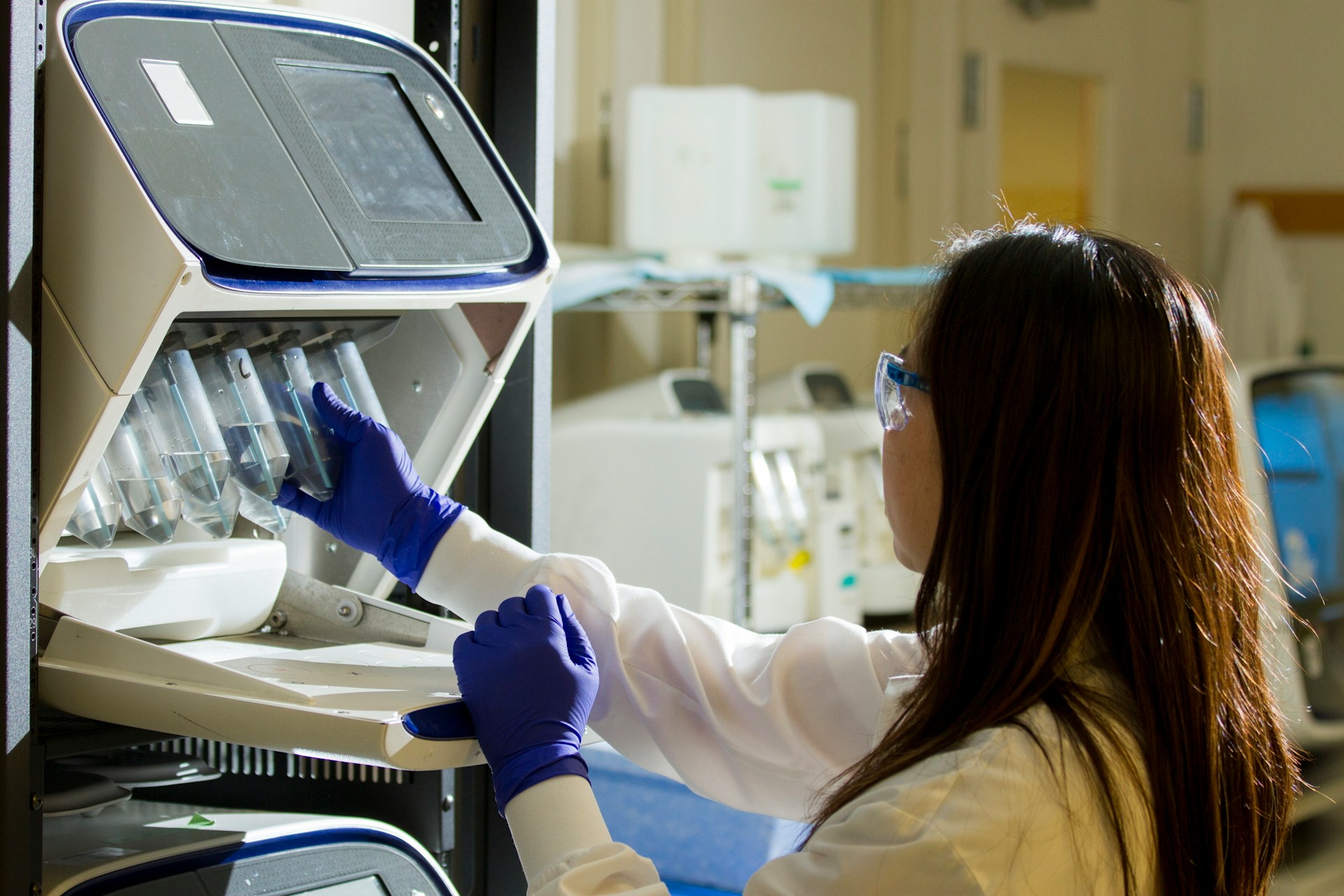
Beneath high support for science, new survey data exposes cracks in trust, engagement, and public confidence. Photo credit: National Cancer Institute via Unsplash
The Public Attitude to Science studies and 2025 survey results
Since 2000, a series of public research studies, the Public Attitudes to Science studies, have been officially commissioned by the UK government to understand public awareness and opinions on science and scientists. The 2025 survey was jointly conducted by IPSOS and The British Science Association on behalf of UK Research and Innovation (UKRI), the largest public research funding body in the UK.
…underneath these seemingly promising trends, a closer examination of the results reveals growing concerns and ambivalence among the public.
The 2025 survey continued to show positive perception of science and technology among the UK public, with 82% of those surveyed thinking that scientists have made valuable contributions to society. Two-thirds of them also felt that science has supported economic growth (64%) and improved lives (67%). Over time, the UK public have become more used to science in their daily lives. Less people reported feeling disengaged by science (22% in 2019 to 16% in 2025) and those rarely or never speaking about science with friends and family (32% in 2019 to 22% in 2025). The public also demonstrated strong support for government investment into science to address societal challenges such as the NHS (97%) and education (92%) and recognised the need to boost the competitiveness of the UK’s science and technology sector on the international stage (75%).
Nevertheless, underneath these seemingly promising trends, a closer examination of the results reveals growing concerns and ambivalence among the public.
Reduced trust in researchers in the public and private sector
The survey revealed that public trust in scientists to follow rules and regulations is affected by who they work for. Compared to the 2019 survey results, public trust in scientists working in universities (87%) and charities (84%) remained similar, but has declined when it comes to those working in government (79% in 2019 to 69% in 2025) and private companies (57% in 2019 to 48% in 2025). The factors reported most likely to harm public trust in scientists were unethical or irresponsible conduct, lack of transparency, and incompetence. Somewhat unsurprisingly, these factors were the opposite of the top traits that people typically associate scientists with, being ethical, competent, and honest. When scientists fail to maintain their reliable image, public confidence falls.
When scientists fail to maintain their reliable image, public confidence falls.
As the boundary between science and politics becomes blurred in government, public opinion on science is more likely an extension of their political view. Work by Sense About Science, a charitable organisation advocating for increased public awareness of science and evidence, highlighted ongoing public demand for increased transparency of evidence used for policymaking. An independent review from The British Academy also raised the importance of transparency, whilst emphasising that science should be a distinct, independent process from politics. Scientific evidence is one of the many elements considered when it comes to policymaking. When scientific evidence does get used in policy decisions, however, its caveats and role in relation to other societal considerations should be openly addressed. This may not always be politically favourable, but will be necessary to project science as the trustworthy pillar that underpins public policies.
Public trust in scientists working for private companies is even lower than for those working in government. This is likely attributed to the public perception that corporate interests and the profit-driven focus in industry may interfere with the findings of privately-funded research. For private companies, partnering with trusted voices such as academic researchers or the NHS to independently demonstrate their scientific robustness may be a way to ease public suspicion. The nature of such partnerships should be made transparent and companies should be willing to disclose non-sensitive data arising from these collaborations. Private companies can also learn lessons from charities, which are more trustworthy in the eyes of the public. Aligning corporate objectives with societal missions and demonstrating how privately-funded research output can support local communities are more likely to build public trust.
Inequality in representation and research outcome
Even though the majority of people appreciated the benefits of science to society (65%), more than half did not feel informed about how it directly supports societal priorities such as growing the economy (62%) or improving the NHS (53%). Also, fewer people felt that science benefits them personally (43%) and nearly half thought that scientific research does not ‘represent people like me’ in its design. In a separate research study from Campaign for Science and Engineering (CaSE), those surveyed also echoed strong support for government investment into research, but voiced a sense of disconnect from the research community and inequalities of research outcome.
In both the Public Attitudes to Science 2025 and CaSE Public Attitudes to R&D 2025 surveys, public opinions differed based on age, gender, educational levels, and socio-economic factors. If the goal is to improve representation in scientific research, researchers should aim to gather diverse perspectives during project design and impact evaluation. Seeing the public population as a singular entity risks further marginalisation and alienation of underrepresented groups already feeling detached from science and research. In-person engagements, such as focus groups and interviews, give the public the agency to share their personal experiences and thoughts on proposed projects, providing a sense of participation and belonging. These personal approaches are also likely to generate unique insights that may be difficult to capture using online questionnaires and surveys, which in turn allows for better and more rigorous science.
Scepticism surrounding emerging technologies
Despite the majority of the public valuing the importance and benefits of science and technology, the survey highlighted general concerns regarding their regulation and risk management. Additionally, the results indicated variable levels of knowledge and perception across different scientific topics.
When questioned on specific scientific topics, vaccination (66%) and mobile phone technologies (53%) were the only two topics where more than half of those surveyed felt informed about. Even among those who felt reasonably well informed about emerging areas such as artificial intelligence (49%) and driverless vehicles (35%), sizable proportions, 36% and 47% respectively, reported wariness about the risks. These levels are comparable to historically polarising topics such as animals in medical research and genetically modified crops, where 37% and 31% of those feeling informed remained sceptical.
These results also indicate that keeping the public informed does not necessarily improve their perception. Simply providing scientific evidence is unlikely to change public minds. Both researchers and policymakers should aim to identify and understand the source of scepticism and address them accordingly. People have a tendency towards ‘confirmation bias’ and are likely to respond positively to information that re-affirms their existing beliefs. Once the seeds of doubt are sown inside people’s minds, they are likely to search for and absorb content that reiterates these suspicions.
The uncertainties surrounding newly emerging scientific innovations make them easy targets for politicised debates and creating polarisation among the public. Unfortunately, those that spread disinformation often manipulate human psychological tendencies and are more likely to gain traction on media platforms. Social media and YouTube are now major avenues through which the public, especially young people, receive scientific information. Only a small minority of people (11%) verify the truthfulness of the information themselves, and almost half rely on their trust in the scientific process or the information source. By using scientific evidence, often misconstrued and out of context, content creators can increase their perceived credibility and gain support from certain demographic groups. Not only does science misuse exacerbate societal divide on these key issues, it also damages the credibility of the research community and harms the reception of public policies.
Scientists should consider embracing these new media platforms to interface with the public and build their understanding of topical, but contentious, scientific issues. Presenting a relatable profile and tailoring the scientific message to account for socio-political nuances are more likely to appeal to a broader audience. Scientists should also paint the full picture when discussing these issues by openly mentioning caveats and gaps in current knowledge.
Why public opinion on science matters for researchers and what can be done
Public trust and confidence in science have implications not just for researchers who want to maximise their research impact, but also the wider academic community and public services that rely on scientific data. Shifting public attitudes can also influence future government strategies and spending decisions, which may have consequences on research funding. When compared to directly supporting priority areas such as policing and housing, the long-term benefits of investing in science, especially fundamental research, may not be as apparent or tangible. Scientific research conducted in academic institutions relies on sustained public funding. Both taxpayers and policymakers need to recognise the value of knowledge building, which lays the groundwork for future innovation and addressing societal challenges. The 2025 survey results indicate that despite the majority of public (64% in 2025) continuing to support the funding of research with no immediate benefits, this majority is smaller when compared to previous years (79% in 2019). UKRI recently announced that it will adopt an ‘outcome-focused, dynamic approach’ to future budget allocation, with an overall increased investment into both curiosity-driven and targeted, priority-guided research, as well as innovative companies. It is therefore worthwhile for scientists, both in academia and the private sector, to develop farsighted engagement strategies to ensure that the public and decision-makers stay informed and optimistic about the benefits of science.
As society becomes increasingly laden with information from all angles…science should remain as the credible beacon of knowledge that the public can count on.
Using science for public good is a shared vision across different sectors, but for researchers, the Public Attitudes to Science study reveals areas for improvement regarding engagement and communication methodologies. When scientific evidence gets used for scoring political points or influencer marketing, its integrity becomes compromised and public trust in science wanes. As society becomes increasingly laden with information from all angles, I believe that science should remain as the credible beacon of knowledge that the public can count on. Now is the time for us researchers to equip ourselves with the engagement and communication skills to take the initiative when the public gets overwhelmed by polarising scientific issues. The research part of science might end at publishing the data, but knowledge is only gained when it is shared with and understood by people.