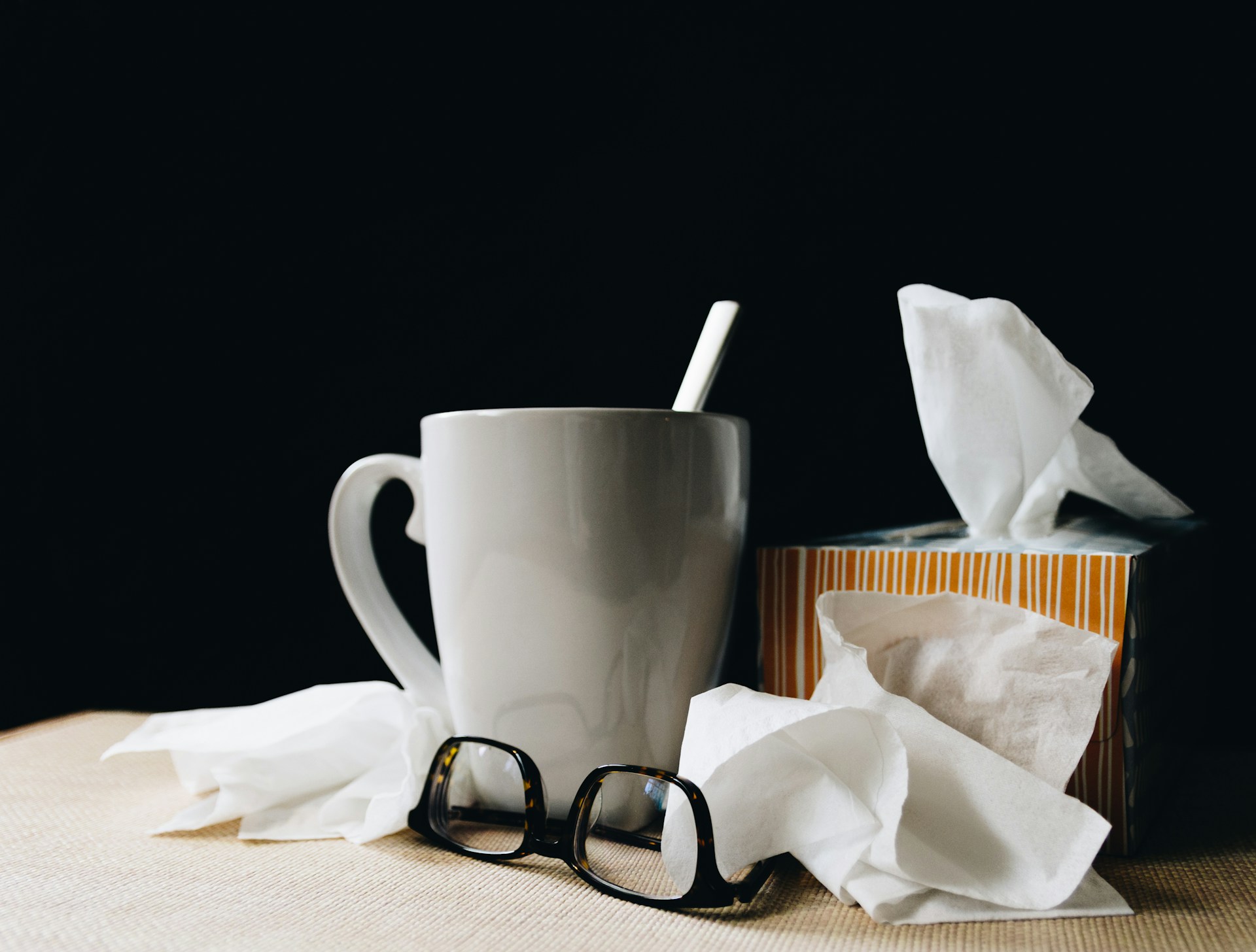
Each autumn, as students arrive in Oxford, “freshers’ flu” quietly spreads alongside the excitement of a new academic year. Photo by Kelly Sikkema on Unsplash.
Throughout one’s life, starting school is notorious for bringing home your own little cocktail of germs and sniffles. Despite no longer being a child, attending university proves to be no different. Year in and year out, as campuses fill with new and returning students, the majority will fall ill with sneezes and sniffles as the weather cools.
Year in and year out, as campuses fill with new and returning students, the majority will fall ill with sneezes and sniffles as the weather cools.
Why we all get sick
As a plethora of common cold strains enter Oxford from across the globe, freshers’ week provides the perfect place for transmission. With over 26,000 students and an enticing list of freshers’ week events, common rooms and dining halls fill to the brim with individuals from 175 countries.
As we get to know one another and form new friendships, rooms are transformed into breeding grounds of close proximity, physical contact, and shared drinks. Even if some follow strict practices of staying at home when symptomatic, others may be asymptomatic carriers, allowing the standard experience of freshers’ week to facilitate disease transmission.
Compounding the effects of physical proximity and shared surfaces, the freshers’ experience is filled with immune system impairing factors. A cocktail of alcohol, limited sleep, stress, and poor diet—all tell-tale signs of classic university life—is thrown at your immune system, weakening your defense against infection.
Ultimately, the university experience is perfect for catching a cold, and as students from around the world begin to share unique strains as they do their names, it’s no wonder we all get sick. But is there something we can, and should, being doing about it?
When do we call something a public health concern?
Defining what is, and isn’t, a public health concern may seem like a straightforward task. However, the answer hides behind a complex decision-making process.
In a 2023 study investigating illness at the University of Cambridge in the 2007–2008 academic year gathered 1076 responses reporting illness, with 97% being from students. The study showed a dramatic peak in new symptomatic cases in October, aligned with the start of the academic year. Furthermore, the study reported approximately 15% of individuals experienced symptoms for more than 7 days, with both social and academic consequences such as missing social activities (39%) and lectures (19%).
We continue to see these trends in recent years, with universities often posting guidance on the freshers’ flu for their own student populations. Having confirmed that the freshers’ flu runs rampant at the start of each academic year, we turn to severity as the final piece in the puzzle.
Whilst the freshers’ flu isn’t known for its severe complications, the real danger lies in hidden infections and vulnerable populations. While generic symptoms such as a runny nose, fever, and headaches might seem harmless, the British Red Cross urges students to consider more severe symptomatic presentation as potential indication of meningitis. However, what might seem like a drastic jump in disease severity is sometimes a terrifying reality.
According to the BBC, in 2024 a student from Wolverhampton believed she had the freshers flu, but was quickly diagnosed with meningitis and required amputations to both her fingers and legs. In light of the recent meningitis outbreak at the University of Kent, this once overlooked dramatization of hidden illness is gaining new light. Now, universities across the UK are jumping to educate their students on prevention and recognition (see Oxford’s information page on meningitis here).
While the only significant threat from the freshers’ flu for most comes from misinterpretation of symptoms, this isn’t the case for everyone. Approximately 4% of the global population is defined as immunocompromised, leaving them at a disproportionate risk for severe complications from everyday illness. Children and older adults are often thought of as vulnerable populations in healthcare, but these are not the typical recipients of the freshers’ flu. Instead, the burden lies among young adults, who are typically presented as medically resilient. However, many young adults live with underlying health conditions and weakened immune systems that leave them immunocompromised.
For immuno-compromised individuals, prevention is the most important factor in staying healthy.
These individuals can face more severe symptoms, and for longer, leaving them at greater risk of complications from common illnesses such as the flu. For immuno-compromised individuals, prevention is the most important factor in staying healthy. So, what can we be doing to help? Techniques to prevent transmission can include vaccination and hygiene (e.g., hand-washing and cleaning surfaces), as well as stronger steps such as masking and physical distancing.
When should we be implementing public health measures?
Despite the wide prevalence of the freshers’ flu, its relatively mild severity often leaves it out of the discussion when it comes to large-scale public health concerns. Although most individuals’ experiences leave them unbothered with a week off sick, public health urges us to consider the greater good of the population. While the freshers’ flu may not meet the conventional criteria for a public health concern, it may be advantageous to look at it, and similar illnesses, with an alternative perspective.
Although most individuals’ experiences leave them unbothered with a week off sick, public health urges us to consider the greater good of the population.
These common illnesses are not necessarily of great concern to every individual, but should be addressed seriously when considering the health of the wider population.
Then, once it becomes clear that communities should act as best they can to protect the health of both themselves and immunocompromised individuals, the question shifts to the root of prevention. Who should be enforcing public health measures, and when?
Who can enforce public health measures?
If the COVID-19 pandemic taught us one thing, it’s that individual autonomy in decision-making is of the utmost importance to much of the global population. Headlines from across the world ignited with debates on the role that governments and institutions have on individual health decisions.
While vaccines for illnesses such as influenza exist, there is no vaccine available for the smorgasbord that is the freshers’ flu. However, even if there was, the COVID-19 pandemic showed that mandating vaccination sparks significant backlash across communities, and with a common cold being less severe for the average person, vaccine mandates would be highly disapproved in today’s society. Similar stories were seen during the pandemic with masking and social distancing, suggesting that even less invasive measures can quickly be deemed unacceptable.
Ultimately, the priority in the context of the freshers’ flu should be to maintain the standard way of living while preventing disease transmission. But if institutions and governments can’t enforce wide-scale public health mandates without backlash, what can they do?
Largely, institutions should work to create environments that inherently reduce disease transmission.
Structurally, research suggests that indoor air quality in classrooms is a major factor in transmission of respiratory viruses. Installation of air filters and/or air quality measuring devices may therefore be of use in disease prevention.
Enhanced cleaning practices also make a huge difference in disease transmission. By implementing more intensive cleaning practices during peak transmission seasons, universities may serve to reduce the number of pathogens left lingering on surfaces. Alternatively, touchless technology such as automatic doors and taps and soap dispensers also serve to reduce contamination of commonly touched surfaces.
However, as with anything, implementation of these prevention mechanisms remains costly, limiting their use.
Where does this leave us now?
Ultimately, the freshers’ flu will likely never be considered a public health concern in the same way that we remember COVID-19. While wide-scale implementation of public health measures may never be addressed in the context of the freshers’ flu, individuals can still follow practices that reduce transmission.
So, while the freshers’ flu may not be a major risk for you, next time you are in the library with the sniffles, consider the health of your neighbor too.
Freshers’ flu teaches us that the behaviour of individuals has profound effects on the health of the population. So, while the freshers’ flu may not be a major risk for you, next time you are in the library with the sniffles, consider the health of your neighbor too.
Some ideas expressed in this article are opinion, and may not represent the opinion of The Oxford Scientist as a whole.