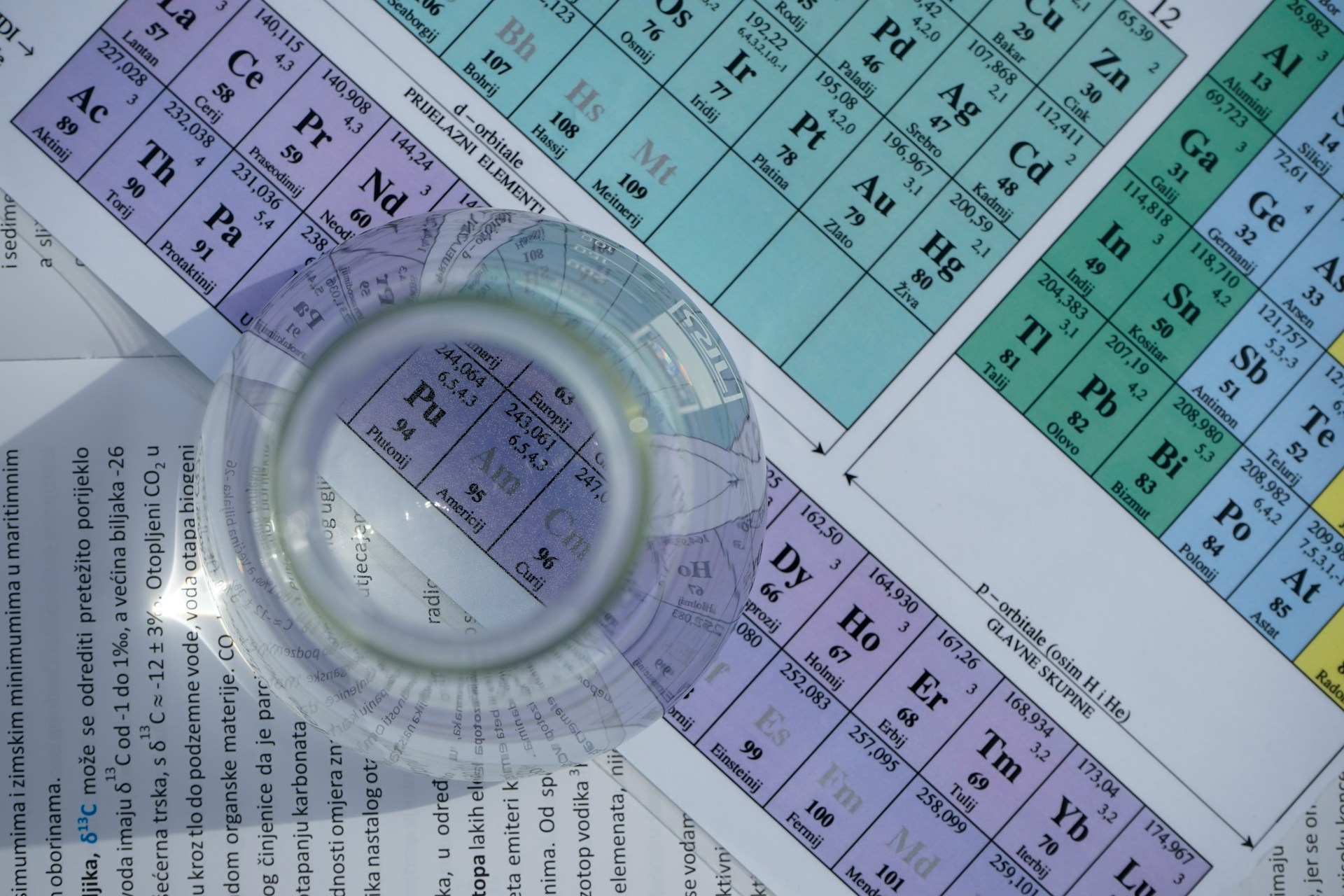
As scientists race to discover element 119, politics and physics have become increasingly intertwined. Photo by Vedrana Filipović on Unsplash.
The periodic table currently ends with element 118, oganesson. First created in 2002 and officially recognised in 2016, it was named after the lead scientist on the project, Yuri Oganessian. Since its discovery, the nuclear science community has turned its head towards the next challenge—element 119.
Element 119, provisionally named ununennium (or eka-francium)…would open up further prospects for key research into the long theorised “island of stability”.
Element 119, provisionally named ununennium (or eka-francium), would begin the eighth row of the periodic table. Its discovery would open up further prospects for key research into the long theorised “island of stability”. Yet the search has been shaped as much by geopolitics as by physics. Over the last decade, shifting international relations have reduced the number of key players in the race to just a few.

Geopolitical Tensions
In 2017, the effort to synthesise element 119 involved a surprising alliance, a three-way collaboration between two US institutions, Lawrence Livermore National Laboratory (LLNL) and Oak Ridge National Laboratory (ORNL), and Russia’s Joint Institute for Nuclear Research (JINR). During that year, LLNL sought to renew a longstanding agreement with JINR, but the request was denied by the US Department of State. The collaboration dissolved, halting a partnership that had previously dominated superheavy element research. Together, JINR’s Flerov Laboratory of Nuclear Reactions and LLNL had claim to the discoveries of the superheavy elements 114, 116, and 118, and helped confirm the synthesis of elements 113, 115, and 117. Discoveries from the most successful superheavy element research group had come to an end.
Left in the race were Germany’s GSI Helmholtz Centre for Heavy Ion Research, the US’s Lawrence Berkeley National Laboratory (LBNL), and Japan’s RIKEN. LLNL would then form a partnership with LBNL, becoming official collaborators on an element 120 project by 2022.
Alongside the breakdown of the JINR-LLNL-ORNL collaboration and the uncertainty that followed, RIKEN was upgrading its equipment and facilities. The laboratory constructed a new superconducting electron-cyclotron-resonance ion source (SC-ECRIS) and a superconducting linear accelerator (SRILAC), which together produce a particle beam five times more intense than the one used in its earlier breakthrough: the discovery of element 113, nihonium, in 2012.
After roughly four trillion collisions, researchers detected just three atoms of element 113, each surviving for around two milliseconds. RIKEN was credited with the discovery in December 2015, and nihonium became the first element to be discovered in Asia. That discovery and its new cutting-edge equipment cemented RIKEN’s reputation as a serious contender in the superheavy element race.
As the US institutions shifted their focus toward element 120, JINR invested $60 million into a new facility at their Flerov Laboratory, which was due to begin experiments to create element 119 in 2019. The following three years saw the RIKEN and JINR projects both in contention to succeed in the endeavour.
Unfortunately for the JINR project, due to Russia’s invasion of Ukraine in 2022, many countries including the US quickly restricted or further restricted ties with Russian research institutions. It became difficult for Russian scientists to collaborate with their international colleagues, access global databases, and import crucial equipment. Since then, it has continued to look as though RIKEN are the natural leaders in the race for element 119.
Attempts for this discovery seem embroiled in political turmoil, with turbulent international relations slowing or halting progress on some of the projects at the forefront of the research. Controversy around element 119 is not unique, however. In 1999, researchers at LBNL reported the synthesis of element 118, but after subsequent experiments failed to confirm the discovery, they retracted their results. An investigation later found that evidence supporting the production of the claimed three produced atoms had been fabricated by one of the key researchers.

The Challenge of Superheavy Element Synthesis
The creation of element 119 has proved a challenge due to external factors so far, but there are also inherent difficulties in the synthesis of this element as we move beyond the seventh row of the periodic table. As researchers attempt to create heavier and heavier elements, the task becomes increasingly challenging. As atomic number increases, so does the repulsive Coulomb force between protons in the nucleus. To create a superheavy element, two already large nuclei must overcome this repulsion and fuse. For such high atomic numbers, the probability of fusion becomes vanishingly small, and trillions of collisions are needed to obtain a reasonable probability of producing the element.
To create a superheavy element, two already large nuclei must overcome this repulsion and fuse.
Detection presents an additional challenge. Half-lives for elements of such high proton number tend to be the shortest of any, and so once the nucleus is created, it doesn’t stick around. Detectors must be capable of operating on tiny timescales to make sure the short-lived decay signals which indicate the element’s presence are not missed.
Because of these inherent challenges, the most recent element discoveries, those larger than element 113, have relied on hot fusion. This involves conducting the experiment at temperatures regularly reaching hundreds of degrees Celsius. Having last used a cold fusion method to synthesise element 113, RIKEN has since had to adapt to this new, more aggressive method of colliding nuclei. Since its equipment upgrade, RIKEN detectors are able to record signals from the reaction more than once per nanosecond, ensuring element 119 will not be missed should it be created.
Alongside general challenges in creating superheavy nuclei, there are some key difficulties in the synthesis of elements 119 and 120 specifically.
Producing elements 113–118 relied heavily on a calcium-48 beam, which was hugely effective due to its “doubly magic” nucleus. Magic nuclei contain “magic” numbers of protons or neutrons that fill nuclear shells completely, giving the nucleus greater stability despite the strong electrostatic repulsion present between protons. A doubly magic nucleus has a magic number of both protons and neutrons, resulting in a longer lifetime than similar elements. The yield of superheavy elements from the collisions is highest when one of the reactants is doubly magic.
The collision partners with calcium-48 for elements 119 and 120 would ideally be einsteinium and fermium respectively. In practice, this is not a viable approach. Both are taxing to produce and can currently only be made in microgram and picogram quantities, too little to be useful in the experiment.
In the absence of einsteinium availability, researchers must use a non-doubly-magic particle beam in their attempts for element 119. The main alternatives are a vanadium-51 beam and curium-248 target, or a titanium-50 beam and berkelium-249 target. Both options have been in use in element 119 projects, and have their individual benefits and drawbacks. Titanium-50 has a magic number of neutrons so provides stability, however berkelium has a much shorter half-life than curium, and so decays more quickly and the targets must be replaced more often. Vanadium, meanwhile, is cheaper and more available than the titanium alternative.
The RIKEN project ultimately selected the curium-vanadium pair because both are easy to work with from a radiation safety and chemical properties perspective. The pair ‘offer a good balance between the availability of high-intensity beams and target material and the possibility of producing the 119th element’. Experiments began in January 2018, beginning their true search for element 119.
Whilst RIKEN uses only the curium-vanadium pair, projects at JINR and the Chinese Academy of Sciences both have plans for experiments which make use of multiple beam and target combinations. With so many experiments in the works to synthesise element 119 and 120, it is hopeful we will see the successful production of a new element in the coming years, further extending the periodic table and starting a new row.
The Island of Stability
The synthesis of these elements is driven by more than prestige. It is fuelled by the possibility of reaching the “island of stability”, which some researchers predict isotopes of element 119 will reach the shores of.
Before the 1960s, models of nuclear structure predicted the lifespan of elements to continue to sharply decrease with atomic number, in line with half-lives observed for elements heavier than uranium. In 1962, americium-242 was obtained in a nuclear reaction and experienced a lifespan of 0.014 seconds, far longer than models predicted. This prompted the development of a new model, which considered internal nuclear structure to play a significant role in the spontaneous fission, or splitting up, of nuclei. From this model, it was predicted that an “island of stability” occurs, centred around atoms of proton number 114 or 120, with a neutron number of 184. The stability arises in part due to the magic number nature of 184 neutrons or 114 protons. Whilst element 114 and heavier have previously been synthesised, all isotopes created have had far fewer than 184 neutrons.
The most stable isotopes predicted near the island’s centre could have half-lives ranging from seconds to, at the extreme, thousands to millions of years. Alpha decay half-lives of 119 isotopes are predicted to vary from 10^-11 to 10^9 seconds, a huge range which depends on the theoretical proximity of the isotopes to the centre of the island.
Evidence that the theory has merit is already present in observed lifetimes of some isotopes of element 117, which have been measured to be in the millisecond to second range. These times are consistent with predictions made and may indicate that we are already reaching the ‘southwest shores of the island of stability’. Add these results to the slightly slower decay of element 114 than predicted, and the emerging pattern that half-lives of superheavy elements get longer with neutron number, and it seems that the discovery of element 119 will add weight to this exciting theory.
These alien and long-lived superheavy elements could help us gain a deeper understanding of the chemistry of our universe.
Outside of the laboratory, if the island of stability exists, it may be reached via the neutron capture that occurs within dying stars. These alien and long-lived superheavy elements could help us gain a deeper understanding of the chemistry of our universe. Given time to succeed, the ongoing element 119 projects could do more than add a new box to the periodic table; they could provide a further step forward into uncharted territory, testing the limits of nuclear stability.
Edited by Nicola Kalita and Sebastian Evans.