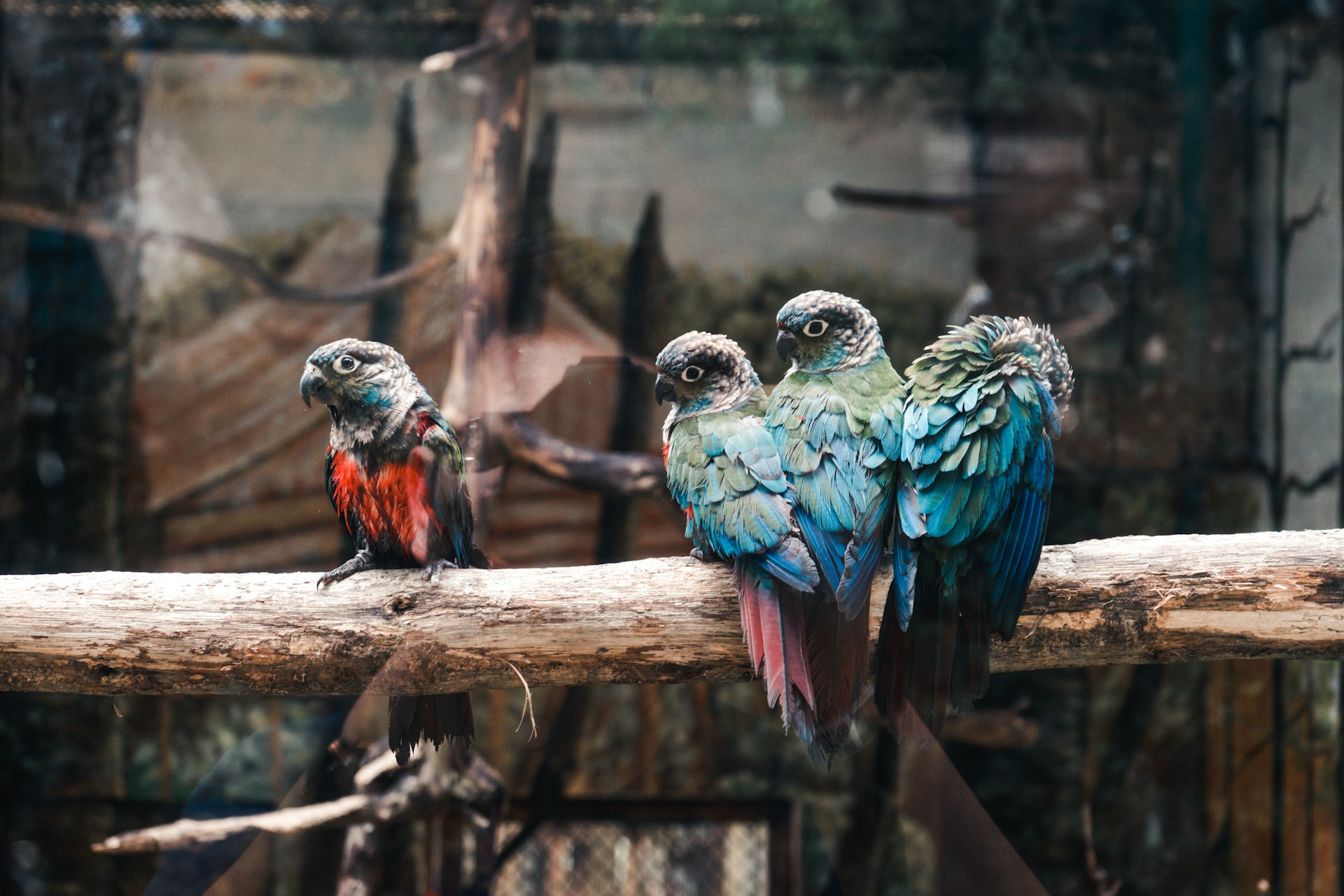
From elaborate animal courtship rituals to humans moving in time with music, dance appears across nature in surprising and meaningful ways. Photo by Ferdy Tjiptoraharjo on Unsplash
From birds’ majestic courting displays to bees directing their hive mates with their moves, how do we see dance across nature? And how and why did it come about in humans?
The spectacle of dance is not limited to a sweaty club night at Parkend or Boogaloo.
The spectacle of dance is not limited to a sweaty club night at Parkend or Boogaloo. Outside of these heaving multicoloured rooms, the ritualised and often complicated movements that define “dance” are used by many animals to attract mates, communicate, form social bonds, forage for food, and vibe to the rhythm.
In courtship, pressure is often placed on males to be the brightest and boldest in order to attract a female mate. Many famous examples come from within the birds-of-paradise family, such as the Western Parotia (Parotia sefilata). Males perform a routine, rhythmically shaking their long and wiry occipital (head) plumes, spreading their flank feathers into a rounded “tutu”-like shape, in addition to intricately twirling footwork. If this sufficiently impresses a watching female, she may choose to mate with him, thereby passing his genes onto the next generation. In this way, sexual selection acts on males to develop increasingly extravagant dances to increase their reproductive success.
Dance can also act as a unifier in the subtle art of reproduction. The breeding pairs of Great Crested Grebes (Podiceps cristatus) perform a peculiar but elegant courtship ritual together. Initially one bird echoes the actions of a leading partner through a series of head shakes and dips. This is followed by the grand finale, where they gift one another pondweed while rising upright out of the water in an impressive display. This dance serves to solidify the pair’s’ social bond for that breeding season, helping successful reproduction and childcare.
But romance is not always the apple of the dancer’s eye. Honeybees are famous for communicating with other members of their hive through a “waggle dance”. Honeybees are an example of a eusocial insect, meaning they live in highly organised social systems with division of labour. The queen bee takes charge of reproduction, while female worker bees forage, protect the hive, and care for the young. In this instance, their use of dance serves an important role in assisting nectar and pollen foraging— increasing the efficiency of honey production. The information encoded in the complex waggle dance points out the location of “high value” flowers to other foraging bees. In the dance, the signaling bee performs a straight run, the length of which scales to the distance of the food source from the hive. Another layer of information is encoded in the angle at which the bee chooses to run at, away from the top of the hive, which corresponds to the angle to take from the sun outside in order to find the flowers.
In another more individualistic method of foraging, gulls (and some other birds, such as thrushes) perform a “rain dance” to tempt worms up to the soil surface. The stamping and tapping of their feet mimic the vibrations caused by the falling of rain and therefore tricks their prey into becoming an easy meal. Why worms surface in the rain is under debate, but several non-mutually exclusive theories suggest that it is easier to move to find new habitats, food sources, and mates when the soil surface is wet. Regardless of the reason, this form of “worm charming” appears to be a tried-and-true method for supplementing a gull’s diet. It is more often seen in birds which need to pad out their diet due to a change of location, such as moving away from coastal food supplies. Niko Tinbergen, the renowned ethologist and recipient of the 1973 Physiology or Medicine Nobel Prize, observed that this dancing behaviour is learnt by young gulls through watching older gulls. Therefore, dance is not necessarily an innate behaviour but can be integral to growing up and surviving in the wild.
Once thought to be unique to humans, studies such as one conducted by Dr Adena Schachner demonstrate that other animals can spontaneously entrain to entirely novel music.
Entrainment (the synchronisation of one system’s rhythm with another) can happen in dance when an animal coordinates their body movement with a musical beat. Once thought to be unique to humans, studies such as one conducted by Dr Adena Schachner demonstrate that other animals can spontaneously entrain to entirely novel music. Her work includes observations of this behaviour in parrots such as Snowball the sulfur crested cockatoo, and Alex the African Grey Parrot. Within the same study, it was concluded that in all the video evidence available, only those species capable of vocal mimicry were also able to show entrainment. Perhaps the coordination of vocal and motor skills for vocal learning led to the evolution of a by-product—entrainment, producing the captivating dance humans are capable of today.
With avid dancers found in every known human society, humans are certainly included in this dancing mix. Our instinctive tapping and swaying to songs underpin many memorable private and social moments, and some of us even pay to watch professionals dance ballet at Christmas. So, what about dancing gives humans so much enjoyment? Humans undeniably evolved dance initially for many of the same reasons as other species, such as to signal high reproductive fitness for mate attraction. But why keep it up, when unlimited access to dating apps and easy foraging in grocery stores, seems to have rendered these old dance motivations unnecessary?
Dance is intrinsic to celebratory gatherings and ceremonies in many cultures around the world, suggesting that it is used both for connection to spirituality and storytelling.
What appears to be clear is that dancing with other humans is a form of social bonding which can enhance trust and cohesion, essential for collaboration and often survival in groups. Dance is intrinsic to celebratory gatherings and ceremonies in many cultures around the world, suggesting that it is used both for connection to spirituality and storytelling. A neuroimaging study in humans found that dancing engages multiple brain regions (such as motor control, rhythm perception and emotion) at once, and that the act of moving in a rhythmic way activates the brain’s reward circuits supplying dopamine to the dancer. Furthermore, a study at the University of Oxford found that both synchronised and high energy dancing is associated with the release of more endorphins than unsynchronised or low energy dancing. Perhaps these findings suggest that we biologically reward higher effort and collaboration in dance, reinforcing the hypothesis that dance is a tool to benefit social cohesion and collaboration in human society.
So, to return to the central question, why dance? A brief survey of the Kingdom Animalia quickly reveals that a wide range of animals shake their hips, heads and feathers in day-to-day life. This unlocks a number of benefits ranging from mate attraction to quicker food foraging, to tighter social cohesion and bonding. Perhaps as a reminder that we aren’t all too different from the rest, humans can just enjoy a good boogie to let loose and celebrate, but aren’t exempt from a little flirting through the means of dance from time to time!