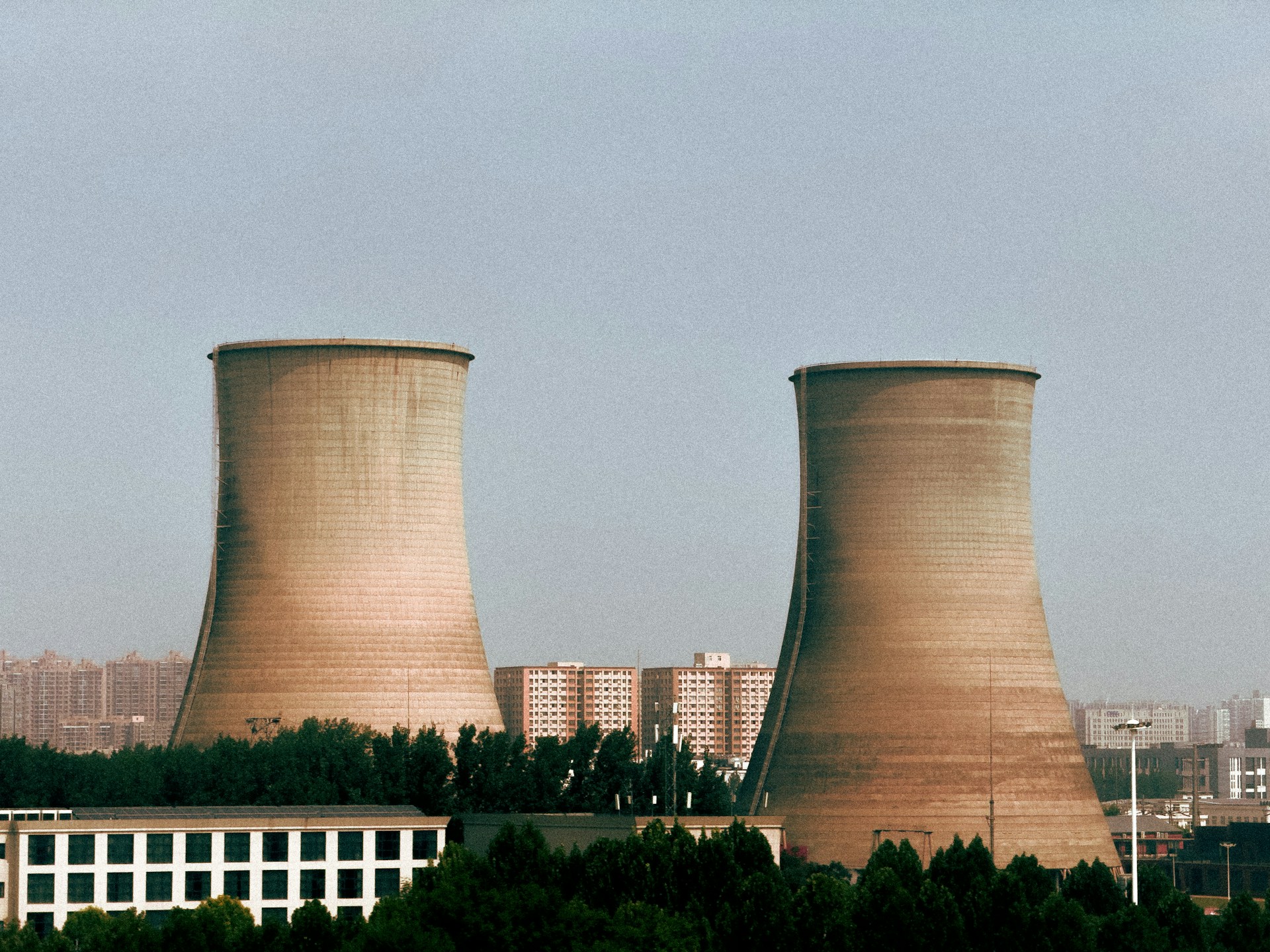
Machine learning is beginning to reveal how data-driven tools could transform one of nuclear energy’s most persistent and complex challenges. Photo credit: Sergio Pérez Mateo via Unsplash
Machine learning (ML) is a branch of artificial intelligence that enables computers to recognise patterns in data and improve predictions without explicit programming.
Across the world, pools and vaults of spent nuclear fuel sit in guarded silence—relics of our race for nuclear energy. Yet hidden within that radioactive legacy may lie a key to the future. Machine learning (ML) is a branch of artificial intelligence that enables computers to recognise patterns in data and improve predictions without explicit programming. Its applications now extend beyond familiar uses such as chatbots and facial recognition. One of its emerging applications addresses a longstanding challenge in the nuclear sector: waste reprocessing.
Clean power, complicated waste
Unlike weather-dependent renewables such as wind and solar, nuclear plants operate continuously, delivering reliable, high-density power that can support a stable, low-carbon energy mix.
Tackling the climate crisis matters now more than ever. Global energy demand continues to rise, and the shift away from fossil fuels has placed new attention on low-carbon alternatives. Nuclear power now supplies approximately 10% of the world’s electricity and demand is projected to increase by over 40% by 2030. Its climate value comes from avoided emissions: nuclear reactors generate electricity without producing CO₂. By this measure, nuclear energy has avoided more than 437 million tonnes of CO₂, roughly comparable to taking over 100 million passenger cars off the road. Unlike weather-dependent renewables such as wind and solar, nuclear plants operate continuously, delivering reliable, high-density power that can support a stable, low-carbon energy mix. Yet behind this promise lies a significant problem: what happens to the waste?
Inside a nuclear reactor, uranium atoms undergo fission, splitting apart to release heat that is used to produce electricity. For every tonne of uranium fuel loaded into a reactor, the entire fuel assembly is eventually removed as spent fuel. By that point, approximately 3–5% of the uranium atoms have undergone fission, meaning the spent fuel consists mostly of unused uranium mixed with fission products. Since the 1950s, the beginning of commercial nuclear power, the world has accumulated over 400,000 tonnes of spent fuel. Most of this material is held in cooling pools, deep water tanks that remove residual heat and shield radiation in the first years after discharge. Once cooler, the fuel is transferred into dry casks (sealed containers made from steel and concrete) used for interim storage. Such systems are essential because spent fuel remains both hot and greatly radioactive for decades.
A long-term solution, however, has proved elusive. Geological disposal requires stable rock formations and political consent, conditions that many nations have struggled to secure. Without these, the risk remains that long-lived radioactive isotopes such as caesium-137, with a 30-year half-life, could escape into soil or groundwater if containment fails. This enduring hazard is what makes safe, permanent disposal so challenging.
Nevertheless, spent nuclear fuel still contains approximately 95% uranium and 1% plutonium, both of which can be recycled into new reactor fuel. Uranium remains the primary fuel because its isotope, uranium-235, undergoes fission readily. Plutonium-239 is also formed during reactor operation and is used to make mixed-oxide (MOX) fuel, an alternative fuel source. Instead of leaving these valuable elements unused, reprocessing allows them to be recovered and reused, reducing the volume of long-lived radioactive waste that requires secure containment. Reprocessing also has benefits for sustainability and business by reducing pressure on uranium mines, shorter lifecycles of waste disposal, and more efficient fuel recovery, providing benefits for both plant and nuclear plant.
The chemistry behind waste reprocessing
For nearly a century, the nuclear industry has relied on PUREX (Plutonium Uranium Redox Extraction), a chemical separation method first developed in the 1940s during the Manhattan Project. This process takes place at specialised reprocessing facilities, where spent fuel is broken down and dissolved in concentrated nitric acid, producing a radioactive solution of uranium, plutonium, and fission products. Solvent extraction using tributyl phosphate (TBP) then can draw out more than 99% of the uranium and plutonium, leaving behind most fission products and other unwanted radioactive isotopes.
Understanding and controlling solvent extraction methods such as PUREX determine how effectively uranium and plutonium can be separated from radioactive waste. It is critical for cost and waste reduction. For decades, scientists relied on conventional methods to understand these processes. This includes simplified thermodynamic models, which assume ideal chemical behaviour, and laborious hot-cell experiments, where highly radioactive samples must be handled behind shielded windows. These methods are slow and expensive, often failing to capture how real PUREX systems behave, as the chemistry depends on several interacting factors at once. Small changes in acidity, temperature, or solvent composition can shift extraction behaviour in ways that simple equations cannot predict.
Smarter tools for an atomic problem
ML helps by analysing large collections of past data to predict the chemical parameters that control separation. Examples of this include nitric-acid equilibrium levels, distribution coefficients for uranium and plutonium, and extraction efficiency under different operating conditions. In a 2024 study, Harilal and colleagues trained ML models on decades of extraction data and achieved R² values between 0.92 and 0.97, meaning that predictions closely matched real measurements. The average error was less than 0.1 mol per litre. Such accuracy allows researchers to map how the system behaves and choose the best test conditions before performing any radiochemical experiments.
Additionally, a major review of ML in nuclear materials science shows that models are typically 10–30 times faster than conventional computational tools such as density functional theory or molecular dynamics. With this speed, researchers can explore much larger regions of chemical space, including the full range of acidities, temperatures, solvent compositions, and metal-ion concentrations that influence separation chemistry than ever before.
ML is also changing how reprocessing plants can be monitored and controlled, particularly for more complex systems such as TRUEX (TRansUranium Extraction), a cousin to the PUREX process. PUREX efficiently separates uranium and plutonium, but TRUEX extends this chemistry to recover additional actinides (a series of radioactive elements) that PUREX leaves behind. Further extraction stages are added, which make the process far more sensitive to operating conditions. Studies show that a 5–10% change in nitric-acid concentration or a ±2–3°C temperature shift can alter actinide distribution ratios by 20–50%, while small deviations in organic-to-aqueous flow cause measurable stage inefficiencies.
At Idaho National Laboratory, Cooper and colleagues developed a digital twin of a TRUEX extraction cascade. A digital twin is a virtual copy of a chemical process that updates continuously using sensor data to reflect what is happening in real time. Over a series of bench-scale tests, the TRUEX twin used optical spectroscopy and ML-based anomaly detection to identify changes in acidity, temperature, and flow with precision and recall above 95%. Its predicted concentration profiles stayed within 5% of reference simulations. This is crucial as TRUEX is highly sensitive to small disturbances, which can cause actinides to be lost into the waste stream or create waste that must be reprocessed. Early detection of instabilities and operator guidance by the digital twin help maintain efficient separation and reduce the amount of waste generated.
ML models learn patterns from data, so their reliability depends on the quality and range of the information they are trained on.
Together, these studies highlight the power of ML in predicting chemical behaviour accurately. Although this technology is proving useful, it still needs care in how it is applied. ML models learn patterns from data, so their reliability depends on the quality and range of the information they are trained on. Nevertheless, this approach can identify effective operating conditions while maintaining system stability, without the need for repeated hazardous testing. In doing so, it reduces experimental workload and improves control over complex extraction systems, with the long-term goal of reducing waste volumes and recovering useful materials more safely and efficiently.
A cleaner and safer energy future
Machine learning will not remove the risks associated with nuclear power, but it provides clearer insight into the chemical processes that underpin fuel use and reprocessing.
Progress in nuclear energy has always relied on a balance between innovation and caution. From the first commercial reactors in the 1950s to the digital-twin systems being developed in the 2020s, each generation of research has deepened our understanding of how to work safely with the atom. Machine learning will not remove the risks associated with nuclear power, but it provides clearer insight into the chemical processes that underpin fuel use and reprocessing. With careful validation and thoughtful application, these tools could help turn today’s radioactive waste into the basis of a cleaner and safer energy future.