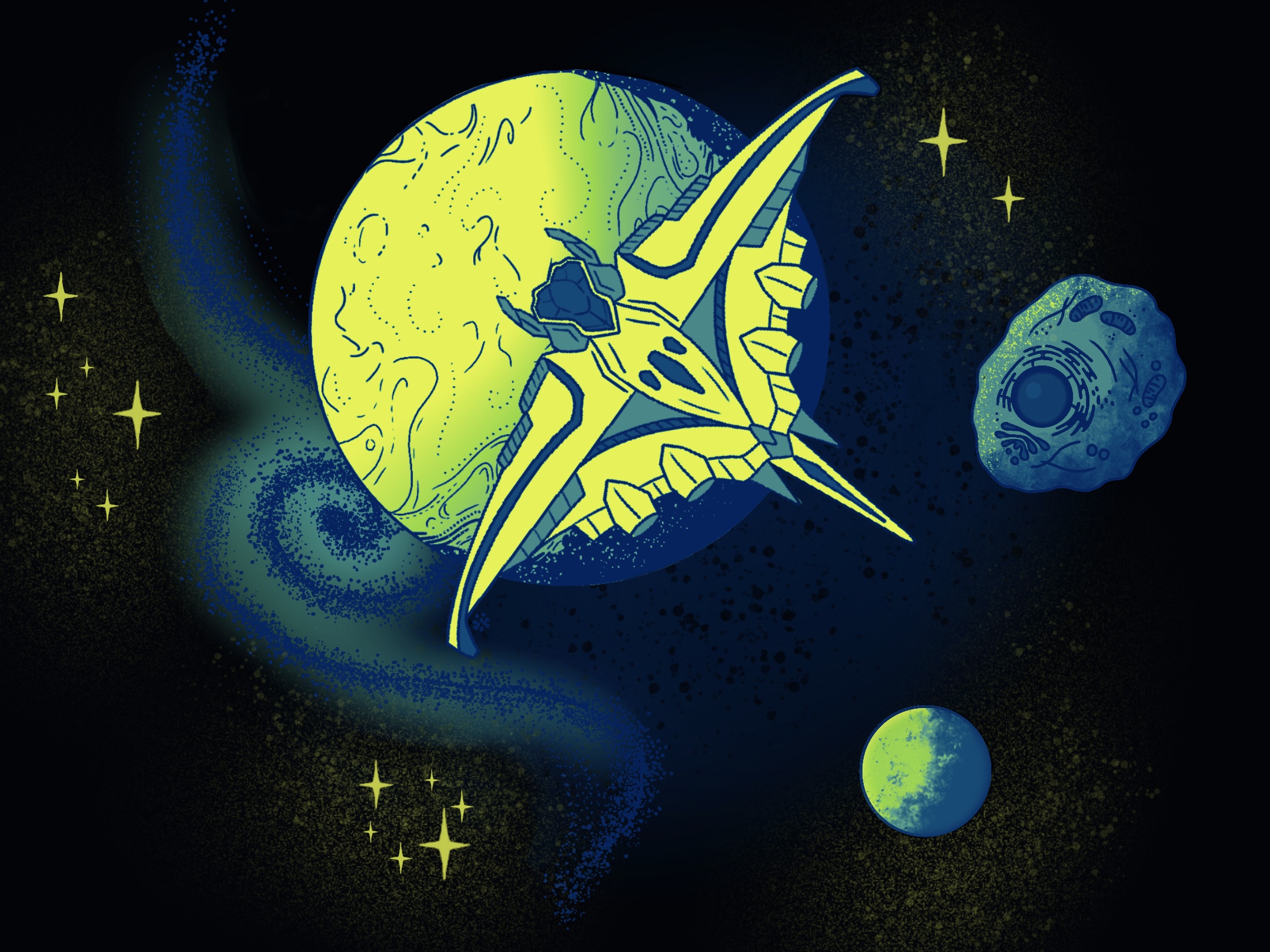
Directed panspermia could deliver us across stars and to the depths of space. Artwork Credit: Madeline Minton via the Oxford Scientist.
What is the first thing that comes to mind when considering how humanity will travel between the stars? Faster-than-light travel, cryostasis, and maybe generation ships are the most popular ideas in science fiction.
Unfortunately, when scrutinising the options that actually obey the laws of physics…our pesky demands for food, water, energy, gravity, and ethical constraints make our desire to reach the stars immensely difficult.
Unfortunately, when scrutinising the options that actually obey the laws of physics, one problem becomes apparent—humans are often the weakest link. Our pesky demands for food, water, energy, gravity, and ethical constraints make our desire to reach the stars immensely difficult. Generation ships, where multiple generations of humans live and die on board, would require an unimaginable amount of resources to keep a human population alive for decades. Even then, the ethical and psychological implications of imprisoning thousands of people on this journey look grim. Meanwhile, freezing people in cryostasis, while sounding more feasible, would require incredible technological advancement merely to reanimate a person after one year, let alone hundreds. So how about we avoid using people altogether?
The concept of panspermia (translating to ‘seeds everywhere’) is the idea that life can exist in space and move between planets, “seeding” them with life.
The concept of panspermia (translating to ‘seeds everywhere’) is the idea that life can exist in space and move between planets, “seeding” them with life. Naturally, people have historically wondered if this happened to Earth, although the idea has fallen out of fashion as more likely explanations for life have arisen (namely, the idea that life formed in hydrothermal vents). From this concept came “directed panspermia”—the intentional seeding of life on uninhabited worlds, masterminded by intelligent life. Cue the even more ridiculous-sounding idea that aliens intentionally put us here on Earth.
Although the belief that directed panspermia explains life on Earth is… unlikely, the concept itself isn’t unreasonable. If we wanted to, we could send life to other planets and moons today, considering that bacteria, fungi, and even tardigrades can survive the vacuum of space. Most of the literature discussing directed panspermia therefore seeks to answer the question: can we, and should we, spread life to other planets?
But this still gets us no closer to an interstellar human civilisation. How can we Homo sapiens, very much vulnerable to the vacuum of space, reach the stars?
A new beginning
In his book, The Songs of Distant Earth, Arthur C. Clarke describes a different type of directed panspermia, where humanity sends ‘seedships’ filled with frozen embryos to potentially habitable worlds in a bid to evade humanity’s extinction. These ships also carry robots that mine resources and look after the population of humans so that a viable colony can be established. A carefully curated databank of technological and cultural knowledge is carried as well, in the hope that eventually, the colonists construct long-distance radio communications equipment that will re-establish contact with the rest of humanity.
The biology seems simple. First, we need to freeze the embryos and ensure they survive the journey. Given that the earliest stages of embryonic development (less than a week old) are simply a clump of cells, freezing a super-early-stage embryo is far easier than freezing an adult human. We’ve been able to freeze and thaw human embryos since 1983 for infertility treatments, and even with our current technology, they can last for decades.
The more difficult challenge is how to get these embryos to grow. Artificial wombs will be required. These do currently exist, but are currently in non-human trials, and are only designed to save dangerously premature, but still viable, foetuses (about 22–28 weeks old). Much more work will be required to grow an early-stage embryo into a person without human intervention.
We could also try freezing sperm and eggs instead. Although this has its challenges, as gametes are more vulnerable to freezing-related damage than embryos are, it would be easier to ethically source a large number of sperm and eggs than it would be to source embryos. Additionally, the more material we send, the more likely our odds of success will be, by preventing inbreeding and increasing tolerance to the occasional losses.
Ascension
But we can make travel even easier. In The Songs of Distant Earth, humanity upgrades the ‘seedships’ to a more elegant design: storing DNA as code in computers, and using that to build DNA molecules (and thereby, the rest of life) at the destination. Significant advances in synthetic biology would be needed to fulfil this dream, but provided that we find a planet with the right resources and develop machines capable of harvesting them, we could potentially build humans anywhere.
This idea hasn’t been ignored by science. In fact, directed panspermia is also considered to be a solution to another one of the daunting challenges we face in space exploration—terraforming. To live on a planet, we need to ensure our pesky demands are met: water, oxygen, soil, and so on. Obviously, this would take a lot of time and effort. But sending micro-organisms to a planet to do the work for us could speed things up significantly. We could even store DNA, either on a computer or physical molecules in the spacecraft, and genetically engineer micro-organisms at the destination so that they are perfectly adapted to the planet’s conditions, producing the materials we humans need, whether that be water, oxygen, or carbon compounds.
Interrogation
Sure, there might be nothing there, but what if there is life on one of our planetary candidates for colonisation?
It is reasonable to ask about the ethical implications of this. Sending life to distant worlds risks disrupting any ecosystem that the planet has developed naturally. Sure, there might be nothing there, but what if there is life on one of our planetary candidates for colonisation? Heaven forbid that life developed differently, such as the “mirror life” we worry could devastate Earth, except in this case, our form of life would be devastating them.
The human aspect may also come with a grave weight. Is it ethical to condemn a generation of people (at least) to a difficult life on a world that they were not made for? What would civilisation look like in its early stages? One of the characters in The Songs of Distant Earth remarks that conveniently, there is no memory of what life was like for the first generations, and probably for good reason. What would even be the point of such an endeavour? Would it merely be a vanity project to spread our species beyond the solar system as quickly as possible, with no clear benefits for us here on Earth aside from thinking it’s neat?
We want to be the ones to see distant worlds and explore the galaxy, not some other race of humans whom we have never met.
It makes sense why directed panspermia hasn’t caught the popular imagination for human interstellar travel. We want to be the ones to see distant worlds and explore the galaxy, not some other race of humans whom we have never met. Nevertheless, it may still be possible for humans to make the voyage away from Earth; it’s just that, just like in The Songs of Distant Earth, the first extraterrestrials we meet could be our own progeny.
Only time will tell.