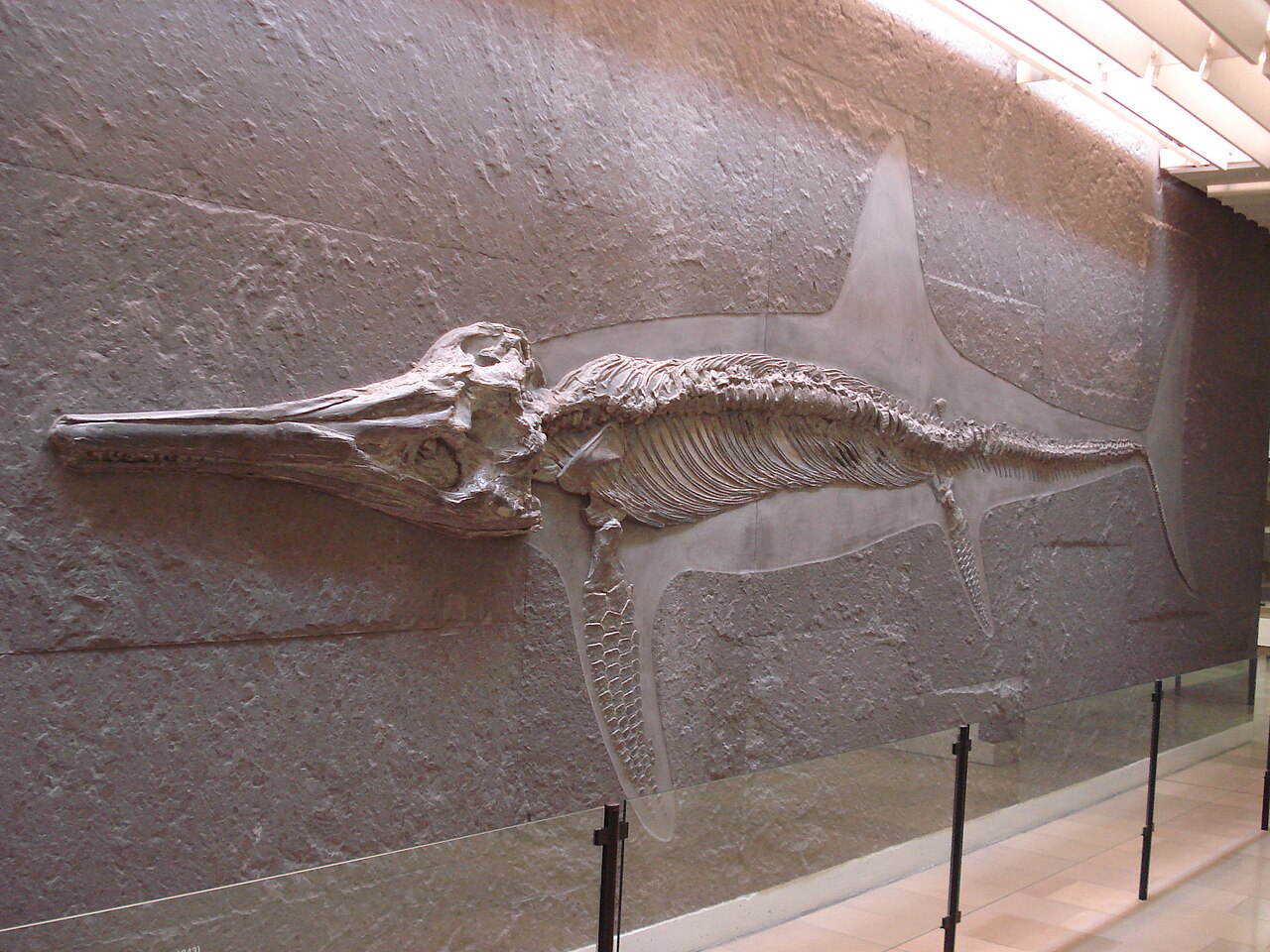
New fossil research reveals how the giant ichthyosaur Temnodontosaurus may have used uniquely adapted flippers to move through ancient oceans almost silently. Photo credit: Ghedoghedo via Wikimedia Commons, licensed under CC BY-SA 3.0
One moment you are swimming through the depths, surrounded by your companions, then a dozen of them simply vanish. An enormous eye looms out of the darkness where they once were, then recedes as quietly as it appears, leaving only a cloud of blood swirling in its wake.
Like many famous members of its now-extinct evolutionary family, the ichthyosaurs, Temnodontosaurus looked like a cross between a dolphin and a shark despite being related to neither.
This may be a reasonable depiction of the perspective of any animal fortunate enough to escape a hungry Temnodontosaurus trigonodon, a ten-metre reptile that ruled the oceans around 200 million years ago, when dinosaurs were still finding their feet on land. Like many famous members of its now-extinct evolutionary family, the ichthyosaurs, Temnodontosaurus looked like a cross between a dolphin and a shark despite being related to neither. They had long toothy jaws, streamlined bodies propelled by fishlike tails that swung from side to side, and sharklike fins on their backs. Every ichthyosaur also bore four flippers for steering, and in the case of Temnodontosaurus, these appendages may have contributed to its success.
New research, led by Johan Lindgren at Lund University, on a well-preserved fossil has revealed the many adaptations displayed by Temnodontosaurus’ flippers. Each of these long, narrow limbs look like wings, with teardrop-shaped cross-sections that would have helped their owners generate lift while minimising drag as they swam. The flippers end in fleshy, flexible, upturned tips that these ichthyosaurs may have been able to bend. Evenly spaced, parallel stripes running from the leading (front) edge to the trailing (back) edge of the fossil flipper imply that tiny ridges, troughs or other structures would have covered the surface of these appendages in life. Finally, serrations run down part of the length of each flipper’s trailing edge, with each serration supported by cartilage embedded in the skin. These are most prominent at around three-quarters the length of the flipper. You might be wondering, what is the purpose of all these strange structures?
…computer simulations showed that the presence of ridges or troughs as well as serrations on Temnodontosaurus’ flippers would have decreased the amount of noise their swimming generated by 4—13 decibels, especially at low frequencies.
Lindgren et al. propose that these anatomical features add up to one conclusion: Temnodontosaurus, despite its great size, was able to patrol its domain in relative silence. Flexible flipper tips, surface structures, and trailing edge serrations would all have reduced the noise made by this sea monster as it travelled. The size pattern of the serrations is notable as it is also present in the fringed trailing edge of the wings of barn owls, which are renowned for their ability to fly extremely quietly. In fact, computer simulations showed that the presence of ridges or troughs as well as serrations on Temnodontosaurus’ flippers would have decreased the amount of noise their swimming generated by 4—13 decibels, especially at low frequencies.
These discoveries, along with several other fossils, has allowed scientists to paint a picture of how Temnodontosaurus might have hunted. With what may be the largest eyes of any animal, this apex predator would have spotted prey even in lightless, nighttime or abyssal waters. With its noise-suppressing flippers, it would have crept up on its unsuspecting targets under the cover of darkness. Then, with its huge cutting teeth, it would have caught, disassembled, and swallowed its food. Squid and their relatives are sensitive to the same low-frequency sounds that Temnodontosaurus’ flippers muffled, which may explain why their remains have been found in this hunter’s stomach. It seems highly likely that these incredible “wings” helped these stealthy sea dragons rule the waves.
We may even be able to learn from the adaptations of prehistoric life to protect life in the present and future.
We may even be able to learn from the adaptations of prehistoric life to protect life in the present and future. After all, squid and ichthyosaurs are far from being the only animals affected by noise — whales, seabirds and many others are, too. Human activities, like shipping and the use of offshore wind farms, produce copious amounts of noise pollution that are disrupting and threatening these creatures. Noise-suppressing structures like those seen in barn owls and Temnodontosaurus could inform the design of propellers, wind turbine blades and other technologies that are less harmful to our ecosystems.