
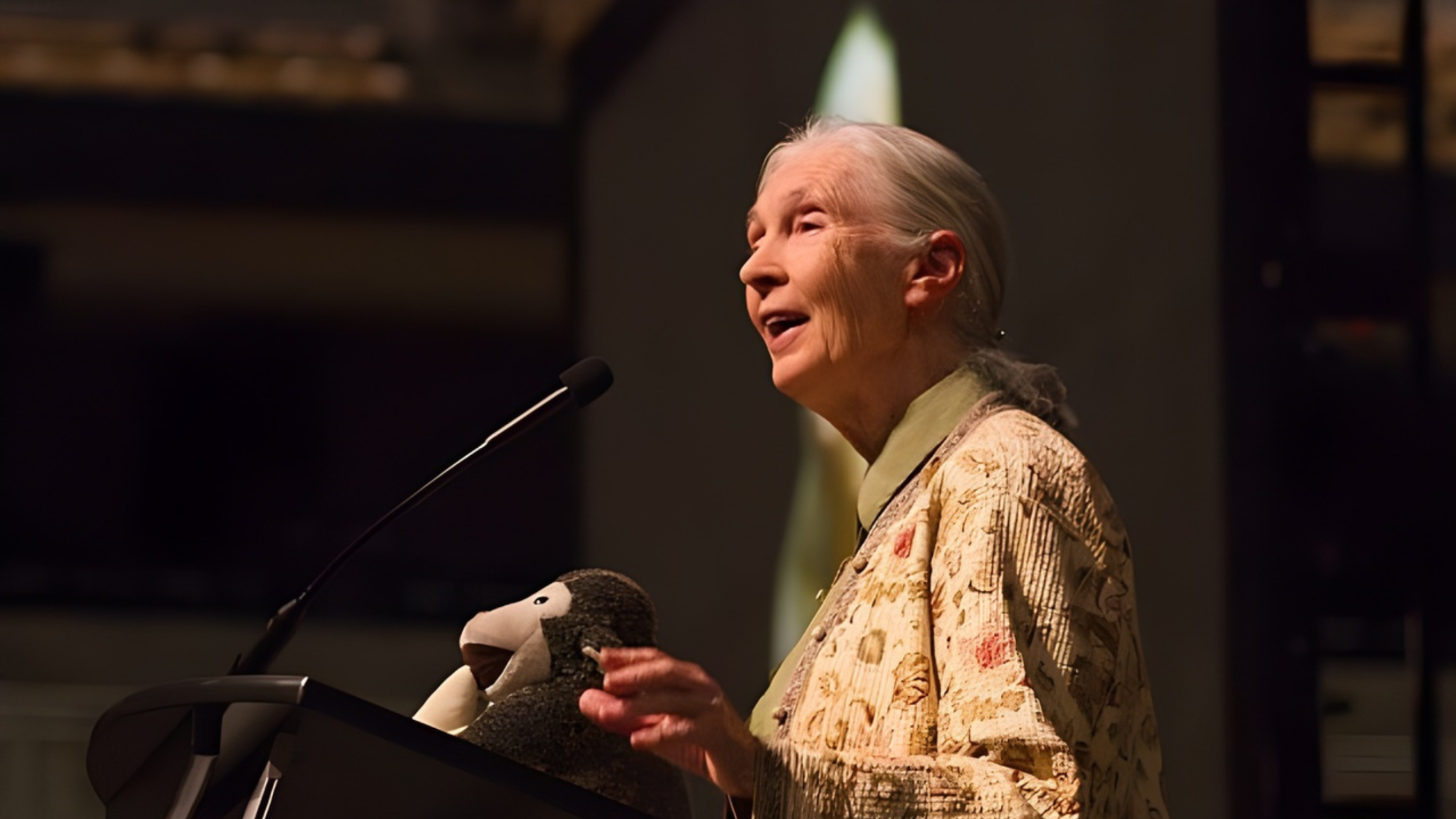
Few scientists have changed how we see both animals and ourselves as profoundly as Jane Goodall. Photo Credit: Mark Schierbecker via Wikimedia Commons, licensed under CC BY-SA 3.0
Dr. Jane Goodall was undoubtedly a pioneer in primatology and ethology—she transformed conservation and opened the door for women in science. Passing away at the age of 91, she left behind a legacy of nature conservation, animal rights advocacy, and humanitarian work. Countless world leaders, friends, and influential figures paid tribute to Goodall. Just reading a few of these tributes reveal how inspirational, determined, and good-humoured she was.
In October, Netflix released an interview with her for Famous Last Words. This is a documentary series where conversations are only released posthumously. In this, Goodall looked back at her life, her regrets, and her private thoughts (including that she would launch Trump, Musk, Putin, and Netanyahu on a one-way trip to space). She also gave her final message:, to encourage us to look after our planet, that our lives matter, and that we can leave the world a better place for the children of today.
Goodall had always been interested in animals. After leaving school, she began to work odd jobs to save enough money to go to Africa. Once in Nairobi, she was told that if she was interested in animals, she should meet Louis Leakey, a British-Kenyan archaeologist and palaeontologist. The pair met at the natural history museum to discuss a secretary position. Despite having no degree, Goodall had taught herself by reading about African animals and visiting the London Natural History Museum, and was able to impress Leakey enough that he offered her the job. At the time, Leakey was researching similarities between existing great ape behaviours and early hominids. So, in 1960, at age 26, Goodall embarked on her first expedition to study chimpanzee social behaviour in Gombe Stream National Park, Tanzania. Here, she was able to integrate herself into the Kasakela chimpanzee community by slowly gaining their trust. During this time, she made a name for herself by making two main discoveries. Firstly, that chimpanzees were not vegetarian as previously thought, and secondly, that they used and made tools (blades of grass and sticks stripped of leaves to “fish” for termites), redefining what separated man from animals. Goodall’s work was then publicised and funded by National Geographic, a documentary was made, and she was invited to go to America to attend a press conference and give talks.
Unsurprisingly, being a woman breaking into science in the 1960s came with its barriers. During her first expedition to Tanzania in 1960, Goodall was barred from working alone as a woman in the field, and was required to have an escort. Her mother volunteered to join her, and within 4 months, Goodall had convinced the authorities she was good enough (or ‘crazy enough’) to go solo. Once her work became publicised, sensationalist articles began to come out surrounding Goodall’s blonde hair and ‘lovely legs’. Whilst these articles were obviously sexist, Goodall was able to use this to her advantage whilst seeking funding: ‘all I wanted was to get back to the chimps. So, if my legs were getting me the money, thank you legs. And if you look at those covers, they were jolly nice legs’.
A large part of the criticism surrounded Goodall naming her chimpanzee study subjects rather than assigning them numbers, which was the common practice at the time.
Despite her lack of formal training as a scientist, in 1966 Goodall became the eighth person to obtain a PhD from Cambridge without a Bachelor’s degree. This, together with being a woman, attracted criticism and cynicism from the scientific community. A large part of the criticism surrounded Goodall naming her chimpanzee study subjects rather than assigning them numbers, which was the common practice at the time. Additionally, she referred to the chimpanzees as ‘my friends’, and suggested that they had emotions and individual personalities, outraging her academic peers. At the time, anthropomorphism was taboo, with emotions and personalities thought to be uniquely human traits. However, Leakey recognised that Goodall’s lack of formal training made her an ideal candidate to study chimpanzees, as she would not be biased by traditional preconceptions. Goodall disregarded the criticism she received and continued to work in Gombe Stream National Park for another twenty years. In doing so, she inspired generations of women to pursue careers in science, with women now making up 57% of the primatology field.
…Goodall founded the Roots & Shoots youth program…a curriculum designed to educate children and young people on environmental and humanitarian issues.
Goodall established the Jane Goodall Institute in 1977, a global non-profit wildlife conservation organisation with the aim of protecting chimpanzee habitats. In 1986, she made the jump from scientist to a full-time conservationist and activist after attending a primatology conference. At this conference, all presenters had noted deforestation in their study areas. Following this, Goodall founded the Roots & Shoots youth program. This is a curriculum designed to educate children and young people on environmental and humanitarian issues. Roots & Shoots proposes active solutions, including encouraging students to engage with local charity projects. Starting with 12 Tanzanian students in 1991, the program now involves 150,000 young people across 130 countries. Later, Goodall established wildlife sanctuaries and reforestation projects and began campaigning for animal rights following her discoveries about tool-use and social relationships in chimpanzee communities. She continued to travel the world to teach about the biodiversity crisis up until her death.
‘I’m not going to give in. I’ll die fighting, that’s for sure.’ (Jane Goodall, 2021)
She created her own opportunities, overcame systematic barriers, stuck with her approach to ethology, and continued to advocate for animal rights and the environment up until her death.
And she undoubtedly did. For almost all her life, Goodall was a scientist and activist. She revolutionised the field of ethology and primatology. She was also a trailblazer for other women to follow in her footsteps into field biology and male-dominated fields. She never toned down her femininity to progress in her career and win her peers’ approval. Goodall should be an inspiration to anyone who knows her story. She created her own opportunities, overcame systematic barriers, stuck with her approach to ethology, and continued to advocate for animal rights and the environment up until her death.

.jpg)