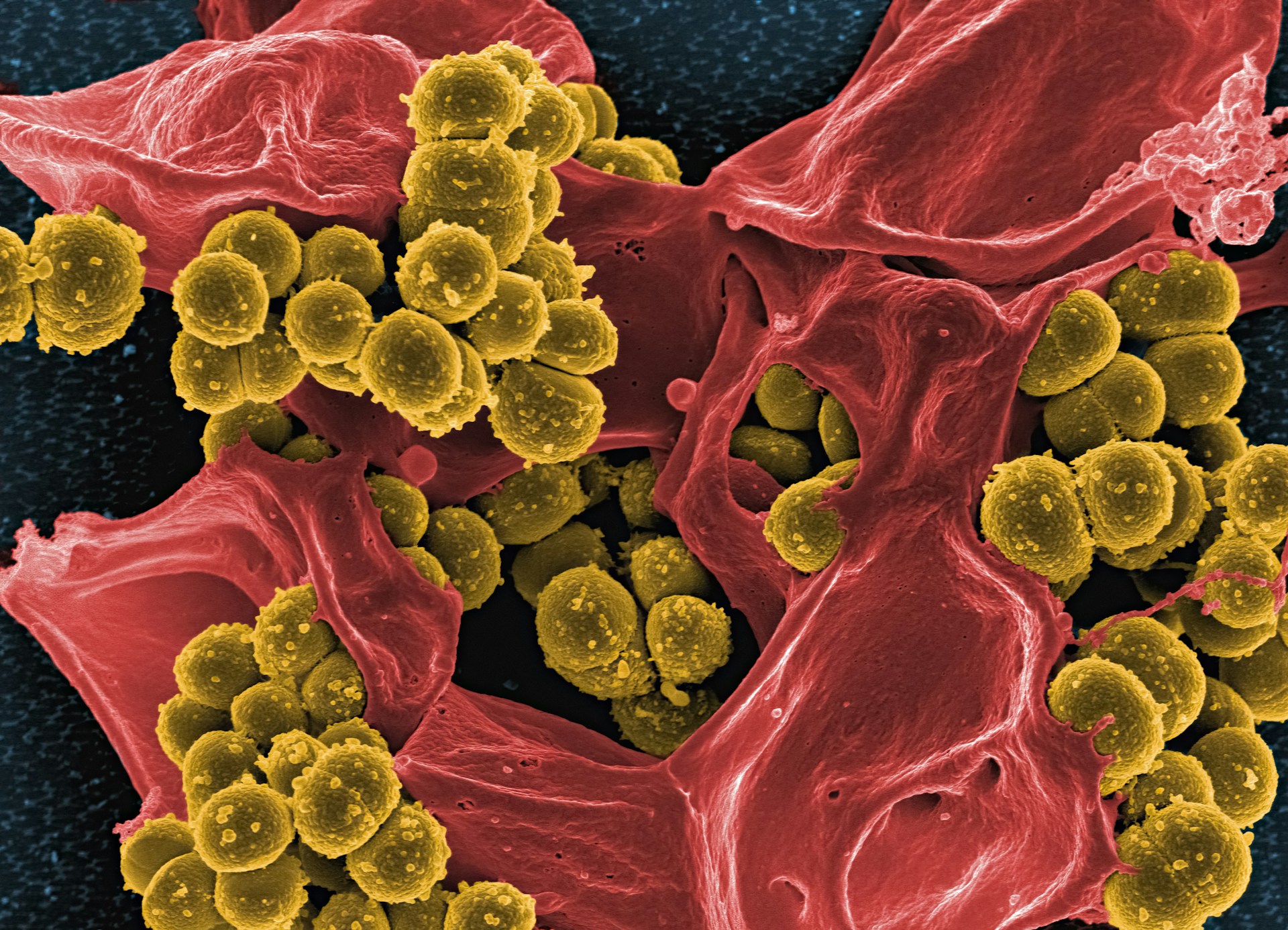
Increasing research into the millions of microbes living within us has provided new insights into the intricate symbiosis between humans and the gut microbiome. Photo credit: National Institute of Allergy and Infectious Diseases via Unsplash.
Ever had a gut feeling or an instinctive sense about a decision or a person you’ve just met? This might be due to microbes in your gut communicating with your brain. Research suggests that the gut microbiome may play an important role in modifying our behaviour, in concert with the immune system and the brain. Microbes influence the pathways between the gut and the brain, known as the gut-brain axis, which are also influenced by factors such as diet, stress, and exposure to infections. Although further research is needed to understand the mechanisms by which microbes influence the gut-brain axis and how this could be used to treat disease, this example represents one of many fascinating investigations into microbiomes and their role in health and disease.
Microbes influence the pathways between the gut and the brain, known as the gut-brain axis, which are also influenced by factors such as diet, stress, and exposure to infections.
Growing research into the human microbiome
Research into the human microbiome has exploded, largely due to the development of genomic technologies and significant reductions in analysis costs. The Human Microbiome Project was launched in 2007 as one of the first large-scale studies investigating the link between humans and their microbiomes, and more than 250,000 papers were published on this topic by 2024. The global microbiome market has grown similarly. It was worth an estimated $1.3 billion in 2024 and is estimated to increase to $8.9 billion by 2034. Alongside this, gut-health testing services by companies, such as the nutrition science company ZOE, are enabling individuals to test their own gut-health and receive personalised nutrition advice to improve their health. This quickly developing field and market can potentially offer new ways to tackle the growing global burden of non-communicable diseases linked to changes in the gut microbiome in response to Western diets.
What is the human microbiome?
Although the terms microbiome and microbiota are often used interchangeably, the human microbiome refers to these microbiota together with their structural elements (e.g. proteins, lipids) and metabolites, such as toxins and signalling molecules.
Within each of us lives a complex community of microbes, consisting of bacteria, viruses, archaea (single-celled microorganisms), fungi, and other microbes, which together make up the human microbiota. Although the terms microbiome and microbiota are often used interchangeably, the human microbiome refers to these microbiota together with their structural elements (e.g. proteins, lipids) and metabolites, such as toxins and signalling molecules. These microbes are concentrated in hotspots in the gut, mouth, lung, vagina and skin, which each contain a different variety of species. Despite the minuscule size of these components that make up the microbiome, altogether it is large, and one person’s microbiome consolidated would measure an estimated three pints in volume or weigh just over a kilogram.
Where does the microbiome come from? These microbes colonise your gut and other hotspots after you leave the largely sterile environment you developed in as a foetus. During vaginal birth, microbes from the mother’s vaginal canal colonise the newborn, or from the mother’s skin if they are born via a caesarean section. New microbes continue to be introduced to infants via breastfeeding, as well as through interactions with other caregivers, and their environment. Approximately two years after birth, the composition of an infant’s microbiome begins to resemble an adult’s microbiome. However, the microbiome does not remain static. Its composition continues to change when an individual’s diet or environment changes, or due to antibiotic treatment. During this process, most new microbes that humans encounter do not become part of their microbiome but are only established if they can compete with the species already present. These variations in its composition over time, as well as between individuals, lead to the question: how is the microbiome related to health and disease?
The microbiome in health and disease
The gut microbiome provides unique pathways for nutrient extraction from our food and is also highly involved in the biosynthesis of more complex organic molecules from simpler ones, such as vitamins, amino acids and lipids.
Most research has focused on the role of the intestinal or gut microbiome in health and disease, due to its massive microbial community of approximately 100 trillion microbes. A healthy microbiome contains many types of microbes, although the exact composition of microbiota varies between individuals, due to factors such as age and diet. This symbiotic relationship between us and our gut microbiome plays an important role in human health, particularly in our nutrition and immune systems. The gut microbiome provides unique pathways for nutrient extraction from our food and is also highly involved in the biosynthesis of more complex organic molecules from simpler ones, such as vitamins, amino acids and lipids. For example, vitamin B-12 is synthesised entirely by bacteria and is used to make red blood cells and maintain the nervous system. Healthy microbiome communities are also stable and protect against external pathogens in what is called colonisation resistance. This is where the established communities of microbes shield against external microbes by competing with them for nutrients, and by producing chemicals and spreading viruses (bacteriophages). This makes the environment hostile for external microbes. In the vaginal microbiome, this colonisation resistance plays an important protective role against sexually transmitted infections and urinary tract infections. Microbiota in the gut may also play a role in the maturation of the immune system, as well as driving the innate (first, rapid, non-specific) immune response against pathogens in the vaginal microbiome.
Microbiota have also been identified as key regulators in the gut-brain axis, modulating the bidirectional relationship. Studies in mice have shown that the gut microbiota influences cognition, anxiety, and depression-related behaviours. Similar results have been found in chimpanzees and humans, although some of these studies were limited in size and did not control for other factors which could have affected these outcomes. Overall, a healthy microbiome is generally characterised by high species and genetic diversity, and aids our nutrition and immune system. What then, characterises an unhealthy microbiome?
Microbiota dysbiosis is…associated with changes to the normal community of species in the microbiome, and subsequently disruption to immune regulation, and chronic inflammation.
Whereas a healthy microbiome is characterised by symbiosis, an unhealthy one is characterised by dysbiosis, which is the imbalance of microbiota. Substantial research in this area has suggested associations between microbiota dysbiosis and diseases such as cardiovascular disease, cancer, inflammatory bowel disease, and neurodegenerative disorders. Microbiota dysbiosis is linked to the development of many of these diseases as it is associated with changes to the normal community of species in the microbiome, and subsequently disruption to immune regulation, and chronic inflammation. Additionally, these diseases are often associated with significant increases in the number of some microbiota species, but significant reductions in the numbers of others. Research in this area is now expansive; however, a key challenge remains in working out whether these changes in the microbiome are just associated with these diseases, or if they actively cause their development and progression.
This improvement in our understanding of the microbiome has led to research into how we can treat or prevent disease. One of the most promising methods now being researched in a growing number of clinical trials is faecal microbiota transplantation. This involves the introduction of a solution of faecal matter from a donor into the intestinal tract of a patient. This has been most successful for the treatment of recurrent Clostridioides difficile infections, which is now approved for use in the UK and is 94% effective, in comparison to the traditional antibiotic treatment used, which is 31% effective. Despite this success, research into the application of this treatment in other diseases is still in the preliminary phases and there is insufficient evidence to estimate how effective it will be.
There is also substantial interest in how probiotics and prebiotics could be used to restore symbiotic microbial communities and to prevent or treat disease. Prebiotics are found in foods that we can’t fully digest but that our gut microbiota can instead ferment and use to produce short-chain fatty acids which benefit our health, whereas probiotics are live microbes. Unfortunately, there is currently limited evidence of the effectiveness of either probiotics or prebiotics for preventing and treating disease. Additionally, there are concerns that some trials which tested probiotics and prebiotics inadequately documented the side effects and so there is a lack of evidence that they are safe.
Antibiotics are another tool for manipulating the gut microbiome to prevent or treat disease. There is some initial evidence that antibiotic treatment can slow the progression of cancer by reducing the microbes that are associated with cancer’s development. Additionally, there is some very preliminary evidence that antibiotic treatments could act as immunotherapy treatments for cancer as they can trigger an anti-tumour immune response in mice models. However, antibiotic treatments risk damaging or eradicating the normal microbiota that contribute to our health and so there are potentially adverse effects. The potential of antibiotics is also challenged by evidence that antibiotic use is associated with an increased risk of colorectal cancer.
There is also growing evidence that microbiota are key mediators of drug responses by increasing or decreasing their effects. Current research is mainly focused on understanding how microbiota affect drug absorption, distribution, metabolism and excretion, which is laying the groundwork for research into how drugs should be adapted to account for these modulating effects.
Remember your microbiome
We often think about the human body as being made up of cells or organs, but we shouldn’t forget the communities of microbes we also share our body with.
We often think about the human body as being made up of cells or organs, but we shouldn’t forget the communities of microbes we also share our body with. From birth, they establish themselves and aid our nutrition and immune system. We then pass these microbial communities on when caring for newborns, and they adapt with us as we experience life and grow old. The mysteries of the microbiome are now being unravelled largely thanks to advances in sequencing technologies. This is providing key insights into many diseases, particularly chronic ones, and has already led to promising treatments such as faecal matter transplantation for recurrent C. difficile infections. This promising and rapidly changing topic is one to watch, as research continues to decipher the secrets of the human microbiome.